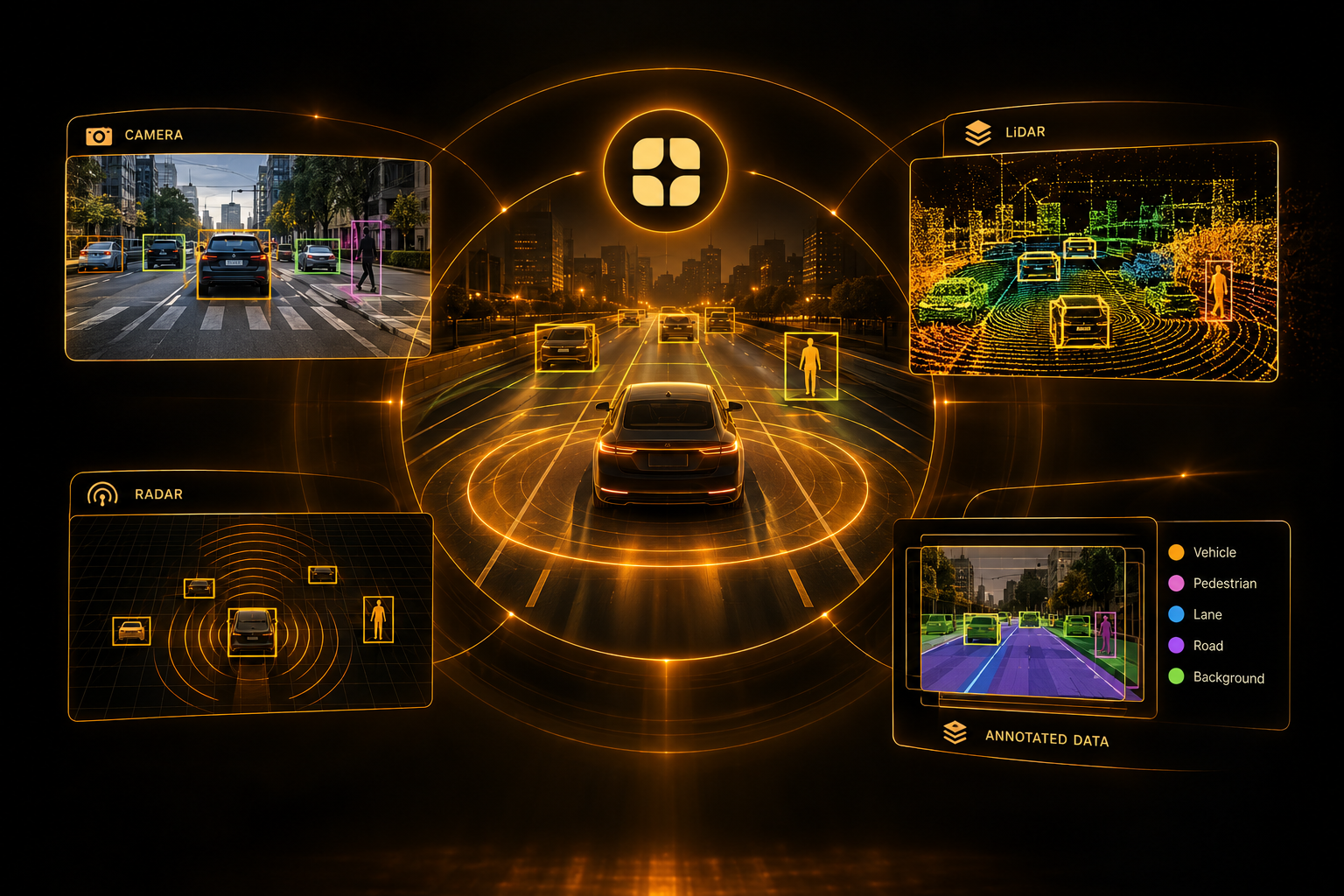
A self-driving system is only as safe as the data it learned from. Before a vehicle can spot a pedestrian, hold a lane, or judge the distance to the car ahead, someone has to label thousands of examples of those moments. That labeling work shapes how the vehicle sees the world.
This is why autonomous vehicle data is one of the hardest annotation problems in AI. The task is not simply to draw boxes on pictures. It means making sense of several sensors at once, across time, in scenes where one mistake can matter a great deal. Generic labeling was not built for this.
Most annotation work starts with a single image and a simple question: what is in this picture? Autonomous driving asks much more.
A vehicle perceives the road through cameras, LiDAR, and radar working together. Each sensor sees something different. Cameras capture color and shape. LiDAR captures depth and 3D structure. Radar helps with distance and movement. The annotation has to line all of this up so the model learns one clear picture of the scene.
At Globik AI, we describe the core challenge this way: multi-sensor annotation for autonomous driving needs an understanding of 3D spatial geometry, object permanence across frames, depth and distance estimation, and edge case recognition for specific scenarios. That is a long list of skills for one labeler.
Many annotation vendors use the same general workforce and the same 2D workflow for every project. This is a problem because driving is a 3D problem. Here is where it goes wrong.
The result is automotive AI training data that looks complete but teaches the model the wrong things.
Good sensor fusion annotation is careful, connected work. The team needs to label the same object consistently across every sensor and every frame. That takes people who understand how the sensors relate to each other, not only how to use a labeling tool.
For autonomous driving, this includes work such as:
Each of these tasks has its own rules and its own ways of going wrong. Matching the right specialists to each task is what keeps the quality high.
In many fields, a labeling error means a small drop in accuracy. In autonomous driving, the stakes are higher. A model that learned from weak labels may misjudge distance, miss a cyclist, or misread a lane. These are safety problems, not just model metrics.
Teams also pay in time. Bad labels have to be found, fixed, and re-delivered, which delays testing and launch. It is far cheaper to get the labels right the first time. If you want to understand why edge cases need special attention, read our post on why edge cases are where AI models actually fail.
Globik AI is not a crowd platform. We deliver domain-specific training data through a verified network of experts, and our Mobility work follows the same approach.
You can see the full range of what we offer on our data annotation services page, or read about our Mobility industry work.
You should not have to trust a vendor blindly, especially with safety-critical data. That is why every Globik AI engagement starts small:
You see production-quality output on a small batch before you decide to scale. No long-term contracts are required.
If you are building perception systems, ask any vendor:
Clear answers show a partner who understands the problem. If you want to talk through your project, start with a 30-minute call. No deck, no pitch, just scope.
A. Autonomous vehicle data annotation is the process of labeling data from cameras, LiDAR, and radar so a self-driving model can learn to detect objects, follow lanes, and understand road scenes. It includes 3D bounding boxes, lane labeling, and scenario tagging. Accuracy matters because the labels directly shape how the vehicle perceives its surroundings.
A. Sensor fusion annotation is the labeling of data from several sensors, such as cameras, LiDAR, and radar, so the same object is identified consistently across all of them. It helps perception models combine different views of a scene into one reliable picture of the road.
A. Automotive AI training data involves 3D geometry, depth, and objects that move across frames. Generic vendors often apply 2D image labeling logic to these 3D problems, which can produce labels that look complete but are inaccurate. Domain-trained specialists understand how the sensors and scenes fit together.
A. Globik AI's Mobility work covers LiDAR point cloud annotation and 3D bounding box labeling, camera and radar sensor fusion annotation, lane detection and road segmentation, HD map data labeling, and ADAS scenario annotation across SAE Level 2 to Level 5.
A. Ask for a scoped phase. At Globik AI, a small, real slice of your data runs end to end in 1 to 2 weeks, so you can judge quality before you scale.
A. Every expert goes through identity and background checks, domain assessment, an AI-led interview, and reference checks before working on a project. Each expert is auditable.