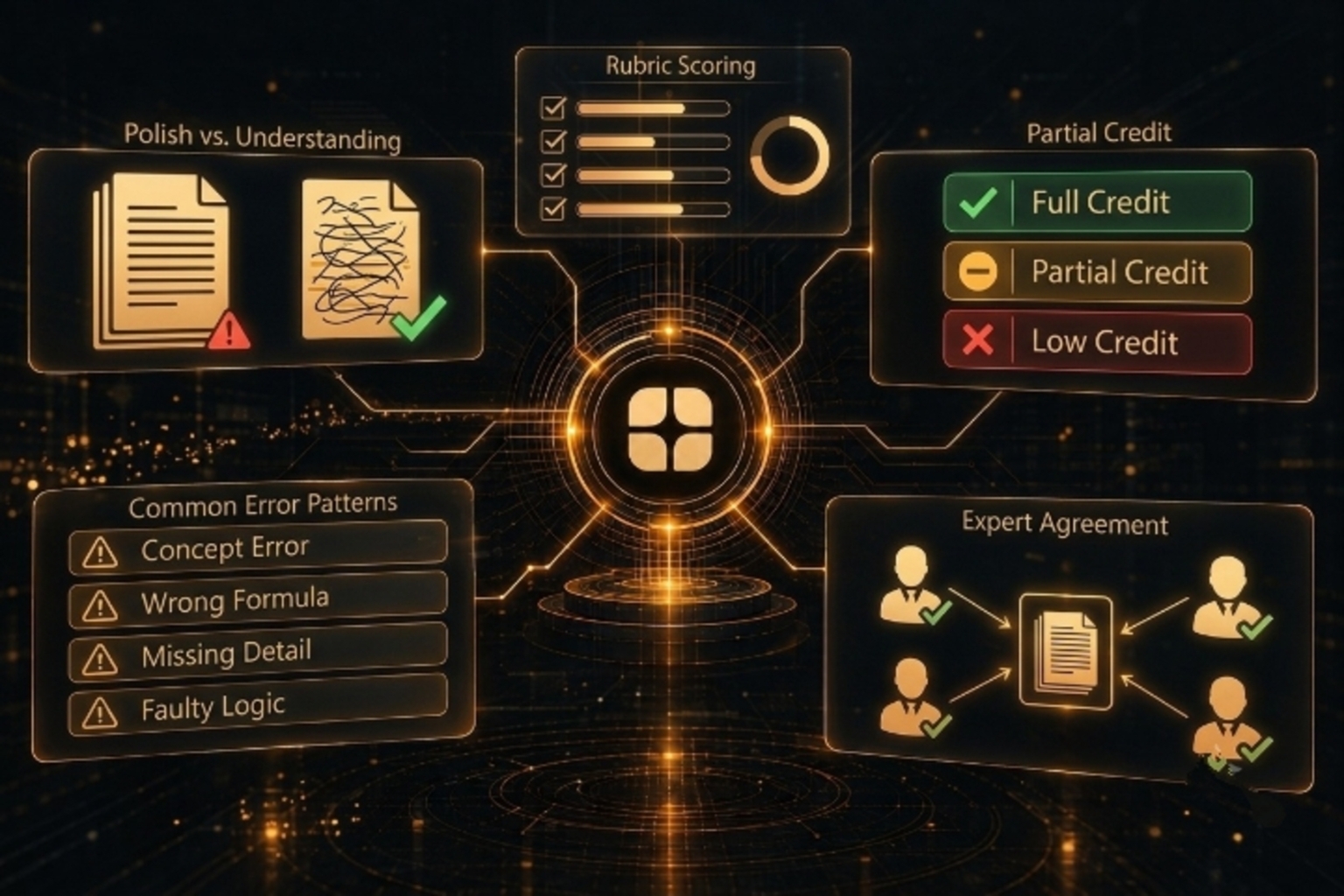
Two students answer the same history essay question. One writes a grammatically flawless response that never actually answers what was asked. The other writes a slightly clunky response that demonstrates real understanding of the underlying argument. A grading model trained on surface features, spelling, grammar, sentence structure, will score the first essay higher. A model trained on data labeled by people who understand the subject will recognize that the second essay is actually the stronger piece of work. This is the gap that separates automated essay and response grading that merely checks writing mechanics from grading that actually assesses whether a student understood the material.
As more edtech platforms add automated grading to reduce teacher workload and give students faster feedback, the quality of that grading depends entirely on how the underlying training data was annotated, and most generic approaches annotate for the wrong thing.
It’s tempting to treat essay grading as a writing-quality problem, since grammar, structure, and vocabulary are relatively easy to measure automatically. But a grading system built only to detect these surface features ends up measuring writing polish, not comprehension. Generic annotation that scores responses primarily on writing mechanics trains a model to reward the wrong thing — it produces a system that can tell a well-formed sentence from a poorly formed one, but can’t reliably tell a correct argument from an incorrect one dressed up in better prose.
Automated essay and response grading that reflects genuine understanding depends on several layers of subject-specific judgment.
Content accuracy assessment. Annotators need to evaluate whether a response actually demonstrates correct understanding of the concept being tested, not just whether it’s well-written.
Partial credit and reasoning quality labeling. Training data needs to capture gradations — a response that shows correct reasoning but reaches the wrong conclusion, or one that reaches the right conclusion through flawed logic, each of which deserves different scoring treatment.
Rubric-aligned scoring. Grading needs to reflect the actual criteria a subject-matter rubric specifies, not a generic notion of “quality.”
Common error pattern recognition. Grading models benefit from training data that identifies recognizable error patterns, rather than treating every incorrect response as an undifferentiated failure.
Consistency across borderline cases. Essay grading inevitably involves judgment calls on responses between two rubric levels, requiring multiple expert annotators to establish consistent scoring boundaries.
A generalist annotator can assess whether an essay is grammatically correct and reasonably well-organized. They cannot reliably judge whether a response correctly explains the causes of a historical event, correctly applies a scientific principle, or correctly interprets a piece of literature, because that judgment depends on actually knowing the subject, not just knowing how to write. The same principle that applies to tutoring and curriculum alignment applies here: subject knowledge isn’t optional, it’s the entire point.
The same standards that curriculum alignment tagging maps content against also need to inform what a grading model considers a correct response, since a response can only be judged “correct” relative to what a specific standard actually requires. We cover this standards-mapping problem in more depth in our earlier post on curriculum alignment tagging.
Take a biology question asking a student to explain why a particular adaptation improves a species’ survival chances. One student writes a polished three-paragraph response that accurately describes the adaptation but never connects it back to survival, missing the actual point of the question. Another student writes a shorter, less fluent response that correctly identifies the causal link between the trait and survival, which is exactly what the question was testing. A surface-level grading model trained on writing quality would likely favor the first response. A model trained on subject-matter-annotated data, where biology-literate annotators have explicitly flagged which response demonstrates the required reasoning, would score the second response higher, because it actually answers the question being asked.
A well-annotated grading dataset should show inter-annotator agreement among subject-matter experts on the same responses, documented rubric criteria that annotators are scoring against consistently, and labeled examples spanning the full range from clearly correct to clearly incorrect, with enough borderline cases to train a model on genuinely difficult judgment calls.
Automated grading that only measures writing mechanics will consistently reward polish over understanding. Building grading systems that actually assess comprehension requires training data annotated by people who know the subject well enough to recognize a correct answer regardless of how it’s phrased.
Because a well-written response can still be factually or conceptually wrong, and grammar checks can’t detect that.
It means annotators score responses against the specific criteria a subject rubric defines, not a generic sense of quality.
Because most responses are neither entirely right nor entirely wrong, and training data needs to reflect that gradation.
Not reliably, since judging content accuracy requires real subject knowledge, not just writing-quality assessment.
Grading can only judge a response as correct relative to a specific standard, so both depend on knowing what a student should know.