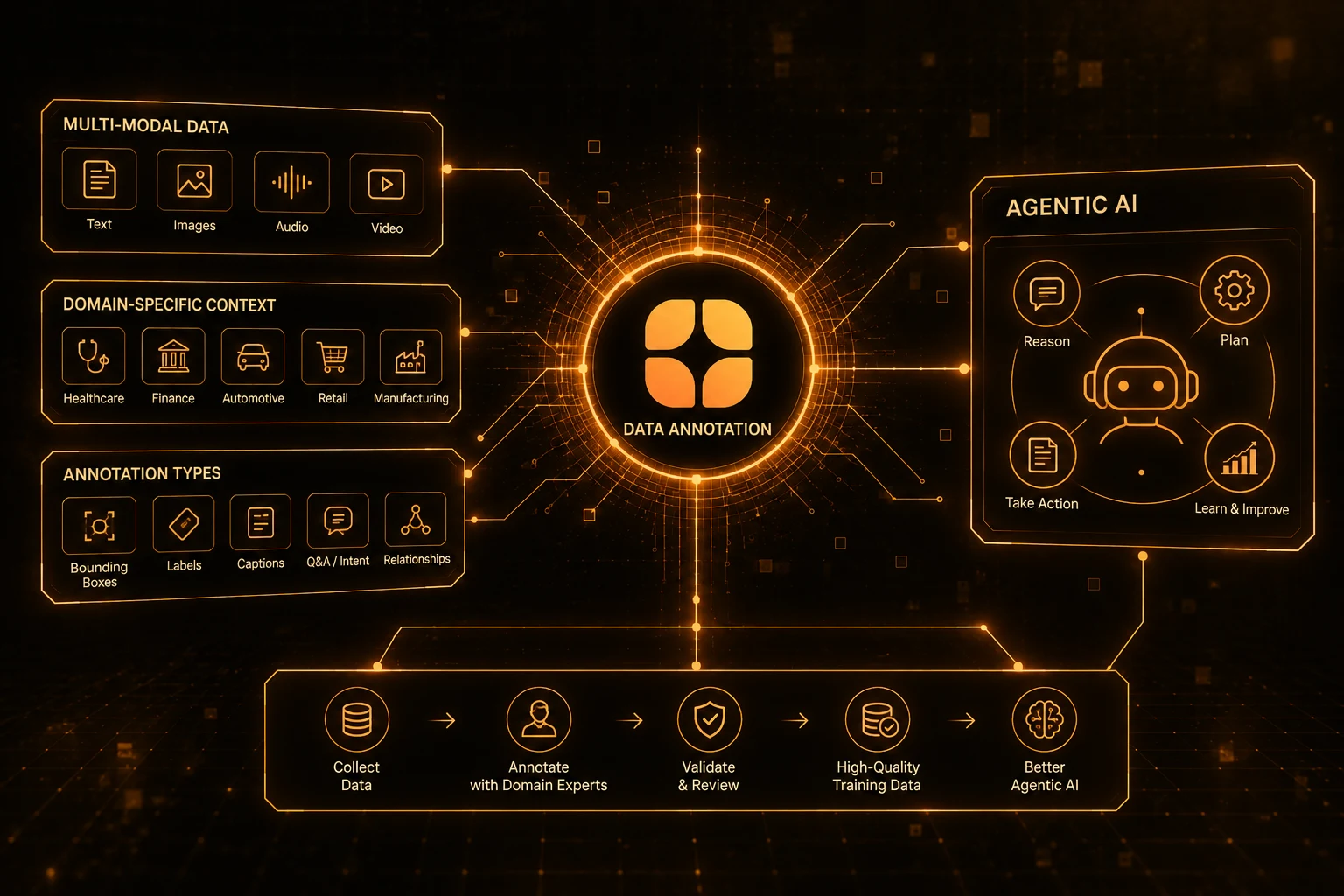
Data annotation for agentic AI is the process of labeling the full sequence of decisions, tool calls, observations, and corrections an AI agent makes while completing a multi-step task, rather than labeling a single question and its answer. It's the training data category behind AI agents that plan, use tools, and take autonomous action, and it requires fundamentally different annotation methods, guidelines, and annotator skills than the data that trained earlier-generation chatbots.
This guide answers the specific questions teams ask when they're trying to understand what this category of annotation actually involves and how to do it well.
Standard chatbot annotation labels a single prompt and a single response. A person asks a question, a model answers, and annotation evaluates whether that one answer was good. This structure works well for conversational AI but doesn't capture anything about multi-step behavior.
Agentic AI annotation labels a full trajectory instead. A trajectory is the complete record of everything an agent did to accomplish a task: the plan it formed, every tool it called, how it interpreted each result, and how it adjusted its approach along the way. Annotating this well means judging the entire sequence as a coherent whole, not just checking whether the final output looks correct.
Tool-use annotation. This labels whether an agent selected the correct tool or API for a given step, formatted the request correctly, and interpreted the tool's response accurately before deciding what to do next.
Reasoning trace annotation. This captures and verifies the intermediate reasoning steps an agent used to reach a decision, checking whether each step logically supports the next one, not just whether the final conclusion happened to be right.
Multi-step trajectory annotation. This evaluates a complete task sequence, from initial goal to final outcome, for overall coherence, catching cases where a locally reasonable decision early on quietly derails the entire task several steps later.
Failure and recovery annotation. This deliberately captures examples of things going wrong, tool timeouts, unexpected errors, flawed assumptions, paired with how an agent should recover gracefully, since production agents encounter failure constantly and need training data that reflects this.
Preference data for agent behavior. This is a form of reinforcement learning from human feedback adapted specifically for agents, where raters evaluate entire action sequences for efficiency, safety, and appropriate caution, not just which of two single responses reads better.
Outcome verification annotation. This connects a labeled trajectory to a confirmed, real outcome, did the code actually run successfully, did the requested action actually get completed correctly, grounding the training data in verified reality rather than plausibility alone.
Because chatbot data was never built to capture the specific behaviors agentic tasks depend on. Static, single-turn text and prompt-response pairs don't contain examples of breaking an ambiguous goal into concrete steps, selecting the right tool among several options, correctly interpreting an error message, or knowing when to pause and ask for clarification instead of guessing. An agent trained without exposure to this kind of data has no real foundation for handling it once it encounters these situations in production, where something failing partway through a task is the norm rather than a rare exception.
Domain expertise relevant to the specific task. Judging whether a multi-step plan or tool call was actually correct in a specialized domain, such as software engineering, finance, or customer operations, requires real expertise in that domain, not just general reading comprehension applied to a transcript.
The ability to evaluate long sequences holistically. Because errors can compound silently across many steps, annotators need to assess complete trajectories rather than reviewing individual turns in isolation, catching problems that only become visible several steps after they originate.
Consistent judgment on genuinely ambiguous cases. Deciding whether an agent should have paused to ask for clarification rather than proceeding autonomously is often a genuinely close call, and this judgment needs to be applied consistently across a large dataset, typically supported by structured guidelines and a defined adjudication process for disagreements.
Reviewing steps in isolation instead of full trajectories. This misses long-horizon errors that only become apparent when a complete sequence is evaluated together.
Collecting only successful task completions. A dataset built entirely from clean, successful examples gives a model no real basis for handling the failures it will inevitably encounter once deployed.
Using generalist annotators for domain-specific reasoning verification. Verifying whether a plan or tool-use decision was correct in a specialized field requires genuine expertise, not just careful general labeling.
Reusing simple pairwise response comparison for agent preference data. This doesn't capture the process-level judgments, efficiency, safety, appropriate escalation, that agentic behavior actually needs to be evaluated on.
Skipping outcome verification. Relying only on whether a trajectory looks plausible to a human reviewer, without checking whether the underlying action actually succeeded, leaves a critical gap between what looks correct and what actually is.
Ask whether their process evaluates full trajectories or isolated turns. A vendor whose review process still centers on single-step evaluation isn't equipped for genuinely agentic AI data.
Ask how they source and label failure and recovery examples. Deliberate collection of these scenarios is essential and easy to skip, so a vendor's specific approach to this is worth probing directly.
Ask what domain expertise their annotators bring to reasoning verification, particularly for specialized applications where general labeling skill isn't sufficient.
Ask how their preference data collection is structured for agent behavior, rather than assuming standard RLHF pairwise comparison methods transfer directly to multi-step agentic tasks.
Ask whether and how labeled trajectories get connected to verified outcomes, rather than relying purely on human plausibility judgments.
Building or fine-tuning an agentic AI system requires treating data collection as a genuinely different exercise than the chatbot fine-tuning many teams are already familiar with. Full task trajectories, not isolated prompts, need to become the default unit of data collection. Failure scenarios need to be deliberately built into the dataset rather than left to accumulate naturally. Domain-qualified annotators need to be involved specifically for reasoning verification, and preference collection needs to be redesigned around process-level behavior rather than simple response comparison. Organizations that start building this kind of data infrastructure early, before an agentic product is close to launch, will have a meaningful head start over those trying to adapt chatbot-era data practices after the fact.
Data annotation for agentic AI is a genuinely distinct discipline from the annotation that trained earlier chatbots, built around trajectories instead of single turns, tool-use and reasoning verification instead of response quality alone, and deliberate failure coverage instead of only clean success paths. Getting this right requires domain-qualified annotators, trajectory-level evaluation, and outcome-grounded verification, not a repurposed version of standard instruction-tuning data collection. For any organization building agentic AI, the quality of this specific kind of training data is what actually determines whether the resulting agent can be trusted to act reliably, not just respond convincingly.
Wondering if your agentic AI data pipeline is still built like chatbot-era instruction tuning? Let's take a look together. Get in touch
It's the process of labeling the complete sequence of decisions, tool calls, and corrections an AI agent makes while completing a multi-step task, capturing the full process rather than just a single question and answer.
Chatbot annotation labels a single prompt-response pair, while agentic AI annotation labels a full trajectory, an entire multi-step task sequence, including tool use, reasoning, and how the agent handled any failures along the way.
A trajectory is the complete record of an agent's actions across an entire task, from the initial goal through every tool call and decision to the final outcome, which needs to be evaluated as a coherent whole rather than as isolated individual steps.
Because production agents constantly encounter tool errors and unexpected situations, and training data built only from successful task completions leaves a model with no real basis for recovering gracefully when something inevitably goes wrong.
Genuine domain expertise relevant to the specific task, the ability to evaluate long, multi-step sequences holistically rather than in isolation, and consistent judgment on ambiguous cases, supported by structured guidelines and adjudication.