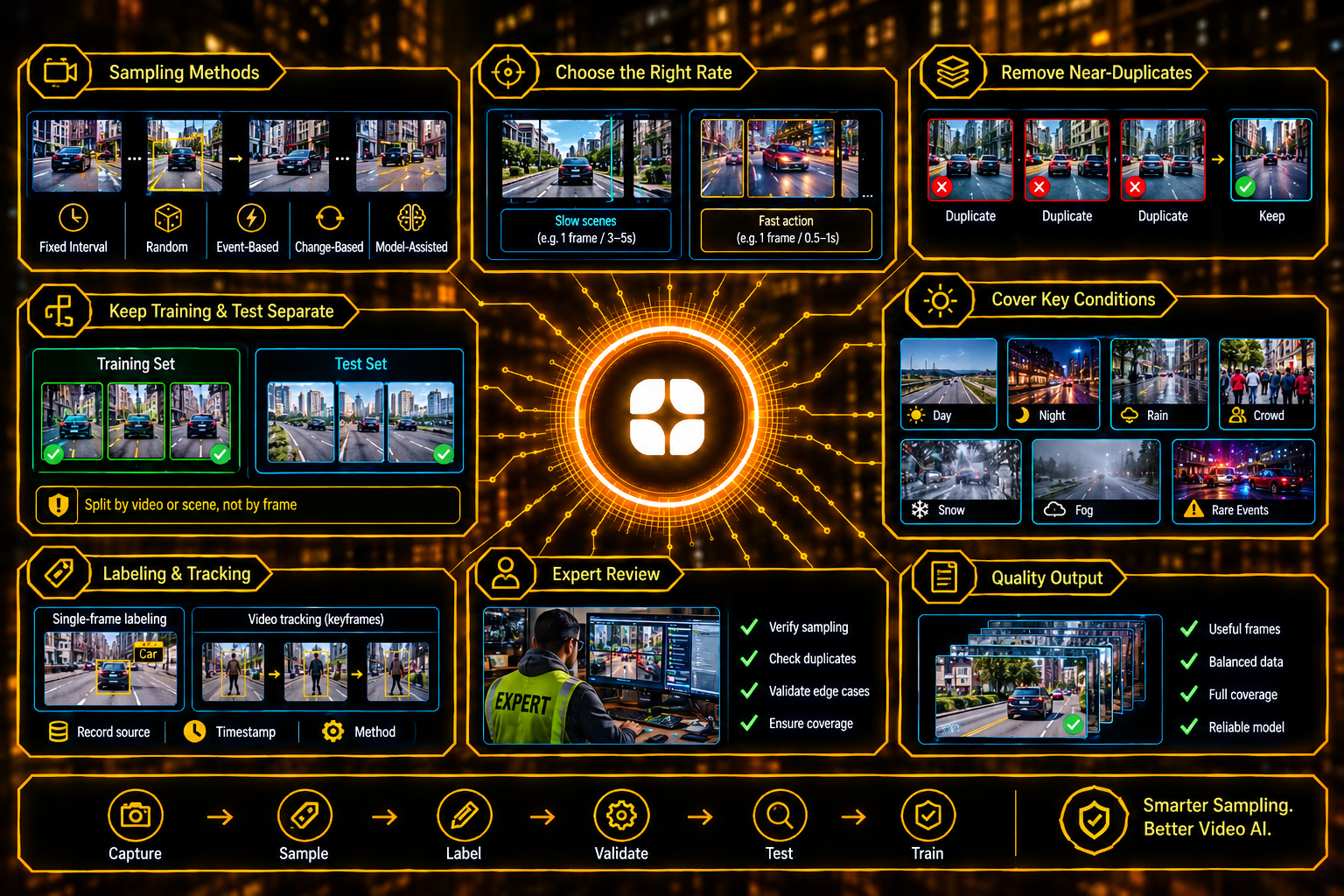
A one-minute video at 30 frames per second holds 1,800 frames. A day of footage from a single camera holds more than two and a half million. Labeling every frame is rarely possible, and it is rarely useful. Most of those frames look almost the same as the ones next to them.
That raises a practical question for any video project: which frames should be labeled? Good video frame sampling for annotation saves time and money, and it also decides how well a model learns. This post explains how to choose sampling rates, handle near-duplicate frames, and keep training and test frames apart. It also covers what computer vision training data needs to stay varied and honest.
Frames that sit next to each other in a video are very similar. A car moves a few pixels. A person shifts slightly. The background does not change at all. Labeling all of them adds cost without adding much new information.
There is also a quality risk. Annotators who label hundreds of near-identical frames in a row get tired, and their labels start to drift. A smaller, well-chosen set of frames, labeled with care, often teaches a model more than a huge set labeled in a rush.
Teams usually pick one of a few approaches, or combine them.
No single method fits every project. The right choice depends on how fast the scene changes and what the model must learn.
The rate should match the speed of the action. A fixed camera watching a quiet corridor can be sampled once every few seconds. A camera on a busy road, or a video of a sport, needs a much tighter rate, because objects move far between frames.
Some simple questions help:
For uneven footage, one fixed rate wastes effort on quiet periods and misses detail in busy ones. A better plan varies the rate with the activity.
The need for frames depends on the type of task.
For an image task, such as detecting objects or classifying scenes, each frame stands alone. Wide spacing between frames is usually fine, since the goal is variety: different scenes, lighting, and angles. Sampling should chase diversity.
For a motion task, such as tracking an object, following a person, or recognizing an action, the model needs to see how things change over time. Frames must be close enough that an object can be followed from one to the next, and labelers need rules for keeping the same identity across frames. Sampling should chase continuity.
Mixing up the two is a common mistake. A set sampled for variety cannot teach tracking, and a set sampled for continuity may be too repetitive for detection.
Even after sampling, many chosen frames can be nearly identical. A parked scene, a still camera, and a quiet night can produce dozens of matching images. Labeling them all adds cost and tilts the dataset toward whatever is most common.
Removing near-duplicates helps in three ways. It reduces labeling cost. It balances the dataset, so rare situations are not buried under common ones. It also lowers the chance that the model memorizes one scene instead of learning a concept.
Teams can compare frames by simple similarity measures and drop those above a threshold. The threshold needs testing, though. Set it too loose and duplicates remain. Set it too tight and useful variety, such as a small movement that matters, is thrown away. A human should review a sample of what was removed.
This is the most important rule, and the easiest to break. If frames from the same video land in both the training set and the test set, the model sees almost the same image in both. It then scores well on the test, but only because it has already seen a near-copy.
The fix is to split by video or by scene, not by frame. All frames from one video, one camera session, or one location go to the same side. For some projects, whole days or whole sites are held out for testing, which gives a much more honest picture of how the model will behave on new footage.
This split must be set before sampling and labeling begin. If it is done afterward by randomly shuffling frames, leakage is almost certain, and the test result cannot be trusted.
Sampling should deliberately include the hard cases. Rare events, bad weather, night footage, crowds, and blocked views are often a tiny share of the raw video, so random sampling may pick up almost none of them.
A good plan checks the sample against a list of conditions and adds frames where coverage is thin. Event-based sampling is useful here. Teams can also keep track of how many labeled frames exist for each condition, so gaps show up early rather than after the model fails in the field.
Sampling decisions change the labeling job. Sparse frames suit single-image labels. Dense sequences suit tracking labels, where an annotator marks an object in a start frame and an end frame, and the tool fills in the frames between. Those filled-in frames still need review, because objects speed up, slow down, and get blocked.
It also helps to record how each frame was chosen: video ID, timestamp, and method. This makes it easy to rebuild the sample later, check for leakage, or add more frames without repeating earlier choices.
People who know the subject understand which moments matter. A reviewer who knows traffic can tell that the few seconds before a stop are worth more than minutes of steady flow. A sports specialist knows which phases of play carry the key actions. A safety expert knows which short events are rare but important.
Specialists help set sampling rates, define events, and review what was dropped. This reflects Globik AI’s approach of using verified domain experts for work that depends on judgment, where a generalist would be guessing.
Before sampling a video project, settle these points:
More frames do not mean better data. Strong video frame sampling for annotation picks frames that add new information, removes near-copies, covers the hard cases, and keeps test footage truly separate from training footage. With that discipline, teams spend their labeling effort where it teaches the model the most. To plan a video project, get in touch with our team.
It is the process of choosing which frames from a video to label for AI training. Instead of labeling every frame, teams select a smaller set that covers the scenes and events the model needs to learn.
It depends on how fast the scene changes and what the model must learn. Quiet scenes need few frames, while fast action needs more. Sampling must be quicker than the shortest event, and varied enough to cover key conditions.
Near-duplicates add cost without adding new information, and they tilt the dataset toward common scenes. Removing them reduces labeling work, balances the data, and lowers the risk that the model memorizes one scene.
Split by video, scene, or location, not by individual frame. All frames from one source go to the same side. This prevents near-identical images from appearing in both sets and inflating test scores.
Specialists know which moments matter in their field, such as the seconds before a vehicle stops or a key phase of play. They help set rates, define events, and check that rare but important cases are included.