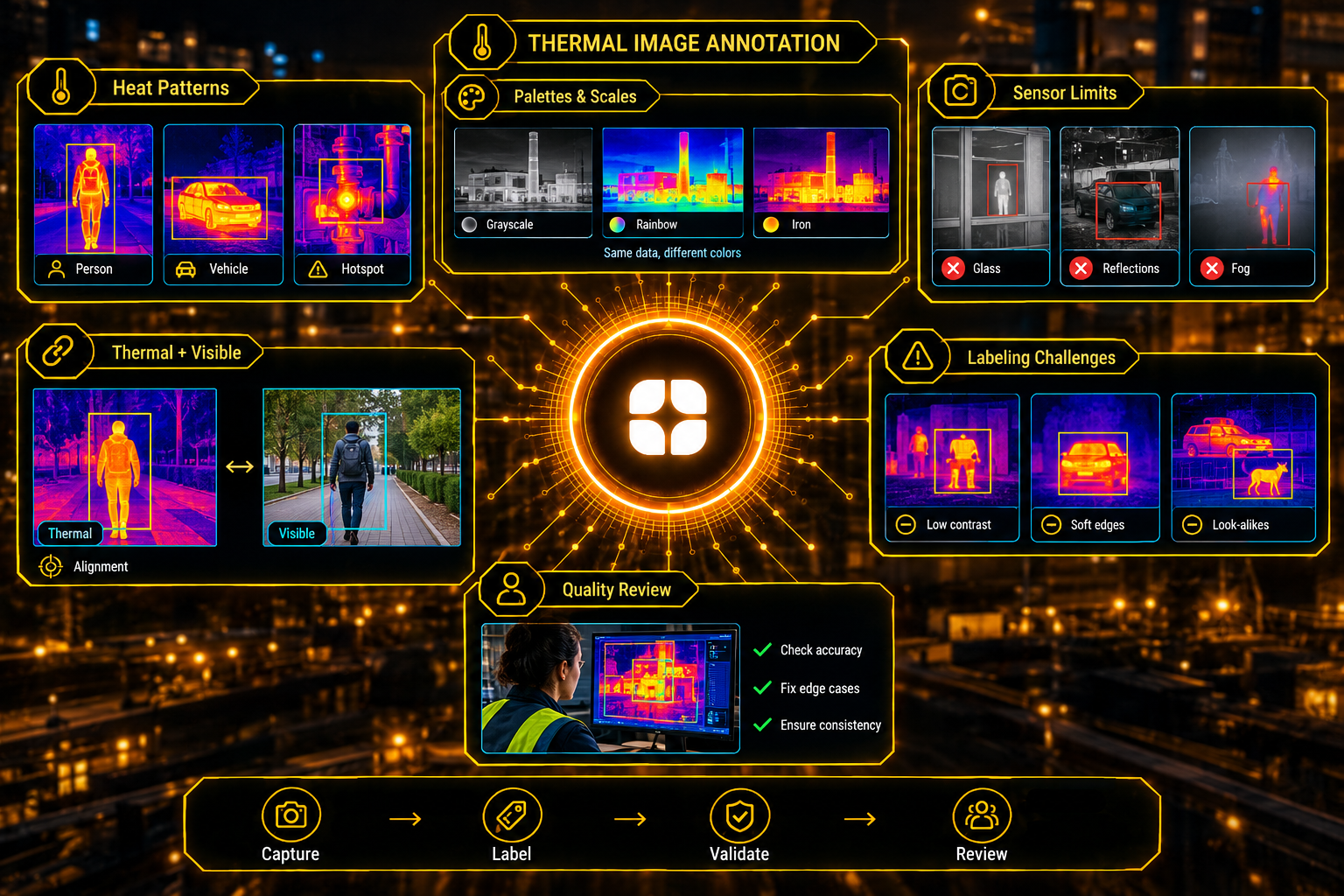
A thermal camera does not capture light the way a phone camera does. It captures heat. Warm objects glow, cool ones fade, and the picture shows temperature differences that the human eye cannot see. That makes thermal imaging useful for night monitoring, equipment checks, search and rescue, and many other jobs.
It also makes labeling harder. Annotators trained on ordinary photos often misread thermal images, because the cues are different. Good thermal image annotation means labeling heat patterns the right way, with rules built for this kind of image. This post explains what thermal images show, where labels go wrong, and what computer vision training data needs when the source is infrared.
A thermal image maps the heat given off by surfaces. Each pixel holds a value tied to temperature. The picture you see is that value turned into shades or colors.
Two points matter for labeling. First, the camera shows surface temperature, not what sits beneath the surface. Second, it shows differences, so an object only stands out if it is warmer or cooler than what surrounds it. A person on a hot afternoon, against a sun-warmed wall, may barely show up at all.
Thermal images are drawn using a palette, which is a color scheme that maps temperature to color. Common choices include grayscale, a rainbow-style scale, and a heat scale that runs from dark to bright orange.
The palette changes how the image looks, but not the data underneath. The same scene can appear very different in two palettes. This causes real problems:
A project should choose one palette and one scale approach, and record it. If raw temperature values are available, keep them alongside the visible image.
Knowing the limits of the sensor prevents bad labels.
An annotator who treats a thermal image like a gray photo will make confident but wrong labels.
Several problems appear again and again.
In visible images, annotators rely on color, texture, text, and sharp edges. Objects are usually easy to name, and the main challenge is volume. Guidelines can lean on common sense and everyday knowledge.
In thermal images, annotators rely on shape, relative brightness, and heat pattern. Objects can be hard to name at all, and the main challenge is interpretation. Guidelines need to explain what each class looks like in heat, with many examples across times of day and conditions.
Reusing a visible-image guide for thermal work is a common cause of poor labels.
Thermal projects need rules that ordinary projects do not.
Where a project also captures a normal photo of the same scene, the two can be paired. A visible image can help an expert confirm what a hot blob really is, even if the model is only trained on thermal data.
Some projects use both thermal and visible cameras. The two sensors have different fields of view and resolutions, so their images do not line up exactly. If a label drawn on one is copied to the other without adjustment, it will sit in the wrong place.
Annotators need a clear method for alignment, and reviewers should check a sample of paired images. Teams should also decide which image is the source of truth when the two disagree.
Thermal footage is often long and repetitive, so choosing which frames to label matters. Our guide to video frame sampling for annotation is a useful companion for thinking through rates and splits. Privacy matters too. Thermal images hide faces, but body shape and movement can still identify people, so access to raw footage should be controlled.
People who work with thermal imaging read these images differently. An inspector who has used infrared cameras knows how a loose connection looks compared with normal load heating, and how reflections create false alarms. A search specialist knows how a person looks against cold ground at night. An agricultural or building expert knows how heat moves through materials.
Specialists write class definitions in heat terms, set the rules for hot spots and faint objects, and review hard cases. This reflects Globik AI’s approach of using verified domain experts for work that depends on judgment, where a generalist would be guessing.
Before starting a thermal labeling project, settle these points:
Thermal images record heat, not appearance, so labeling them well means thinking in temperature, not color. Strong thermal image annotation uses a fixed palette, honest rules about what the sensor cannot show, class definitions built for heat, and reviewers who have read infrared images before. With that foundation, models can find what matters in the dark, through haze, and across changing conditions. To plan a thermal project, get in touch with our team.
It is the labeling of images captured by infrared cameras, where pixels represent heat instead of visible light. Annotators mark objects, hot spots, and conditions using rules built for temperature patterns.
Thermal images lack color, text, and fine texture, so annotators rely on shape, relative brightness, and heat patterns. Objects can be harder to name, which means guidelines need heat-based class definitions and many examples.
A palette changes how the same temperature data looks. Mixed palettes can lead annotators to label inconsistently, and the model may learn the palette instead of the heat. Projects should fix one palette and record it.
They show surface temperature only, not what sits inside objects. Glass can block them, shiny surfaces create false hot spots, and fog or distance weakens the signal. Annotators must know these limits to avoid confident but wrong labels.
Specialists know how heat behaves in real settings, such as how a faulty connection differs from normal warmth. They write heat-based class rules, spot reflections and look-alikes, and review hard cases a generalist would misread.