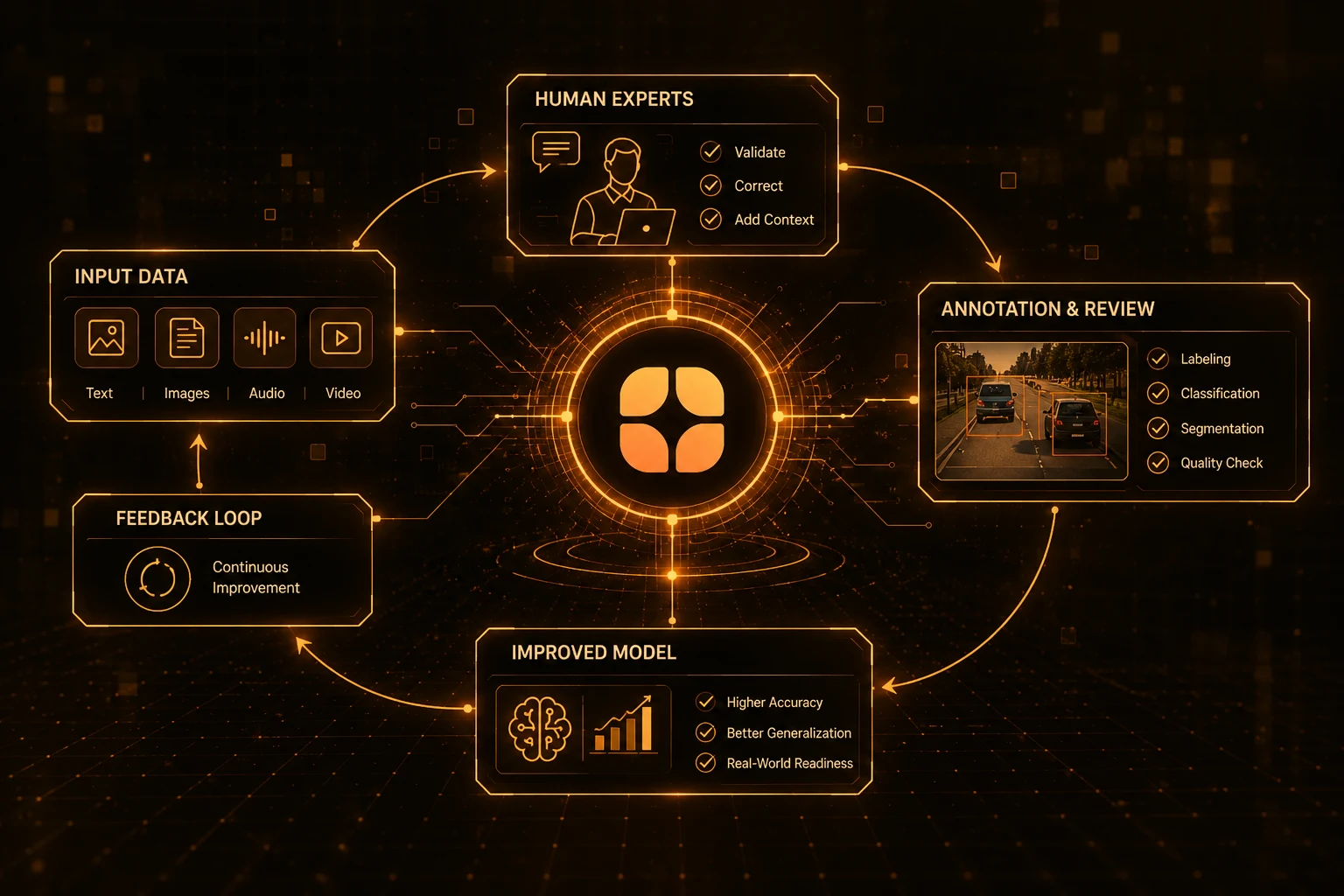
Fully automated AI systems make for compelling headlines, but almost none of the AI actually running in production today operates entirely without human involvement, and the systems that perform best in high-stakes settings are usually the ones that deliberately keep humans involved at the right points, not the ones that try to remove them entirely. Human-in-the-loop machine learning, often shortened to HITL, is the practice of designing AI systems where human judgment is deliberately integrated into the training, evaluation, or operation of a model, rather than treating human involvement as a limitation to be engineered away.
This isn't a step backward from full automation. It's a recognition that certain kinds of judgment, catching ambiguous cases, verifying against ground truth, handling genuinely novel situations, are still best handled by people, and that building this human involvement deliberately into a system's architecture produces more reliable, more trustworthy AI than either pure automation or pure manual process alone. This guide covers what human-in-the-loop machine learning actually means, the different forms it takes, and how to build an effective HITL system.
Human-in-the-loop machine learning refers to any AI system design that deliberately incorporates human judgment at one or more stages of the model's lifecycle, whether that's during initial training data creation, ongoing model evaluation, or live operational decision-making. Rather than a single technique, HITL describes a broad category of approaches united by a shared principle: human oversight and input are treated as a core design element, not an afterthought or a temporary crutch until full automation becomes possible.
This distinguishes HITL from both fully automated systems, which operate without human review at any stage, and fully manual processes, which don't use machine learning at all. HITL sits deliberately in between, using automation for what it does well, speed, scale, consistency at routine tasks, while reserving human judgment for what people do well, handling ambiguity, exercising contextual judgment, and catching errors automated systems structurally cannot detect.
Some judgments genuinely require human understanding. Certain tasks depend on context, values, or nuanced reasoning that current AI systems can't reliably replicate, recognizing when a legal argument is subtly flawed, judging whether a medical image shows an early warning sign, deciding whether an ambiguous customer request needs escalation. HITL keeps these judgments where they belong.
Fully automated systems fail silently on edge cases. Automated systems tend to perform well on the common, well-represented cases in their training data and fail, often without any visible warning sign, on rare or unusual scenarios. HITL provides a mechanism for catching and correcting these failures before they cause real harm.
Regulatory and safety requirements increasingly expect human oversight. In many high-stakes domains, healthcare, finance, legal services, human oversight of automated decisions isn't just good practice; it's an explicit or implicit expectation embedded in regulatory frameworks governing how AI can be used.
Human feedback improves models over time. Beyond catching individual errors, human input captured through HITL systems becomes valuable training data in its own right, helping models improve specifically on the cases where they previously struggled, creating a genuine feedback loop rather than a static, one-time training process.
Trust depends on knowing a human can intervene. For AI systems making consequential decisions, users, whether that's customers, patients, or professionals, often trust a system more when they know a human remains involved and able to intervene, compared to a fully automated black box.
Human-in-the-loop for training data annotation. This is the most foundational form, where humans label, verify, and correct the data a model learns from. Even as automated labeling tools expand, human review remains essential for verifying accuracy, resolving ambiguity, and catching the kinds of errors automated labeling structurally cannot detect on its own.
Active learning. In this approach, a model identifies the specific examples it's most uncertain about and routes them specifically to human reviewers for labeling, rather than requiring humans to label an entire dataset uniformly. This focuses limited human review time specifically where it adds the most value, on the cases a model is genuinely struggling to classify confidently.
Human review and correction during model evaluation. Before deployment, human experts review model outputs against a representative set of test cases, catching errors and quality issues that automated evaluation metrics alone would miss, particularly for tasks where correctness depends on specialized judgment.
Human oversight of live, operational decisions. In this form, a model makes a recommendation or prediction, and a human reviews or confirms it before any action is taken, common in high-stakes applications like fraud flagging, medical diagnosis support, or content moderation, where an automated system surfaces a case but a person makes or confirms the final call.
Human-in-the-loop for continuous model improvement. This involves systematically capturing human corrections and feedback during live operation and feeding that information back into ongoing model retraining, creating a genuine, sustained feedback loop rather than treating training as a one-time, pre-launch event.
Escalation-based human intervention. Rather than reviewing every decision, this form has a model handle routine cases autonomously while specifically escalating ambiguous, high-risk, or out-of-scope cases to a human, a pattern common in customer service and content moderation applications where full human review of every interaction would be impractical.
Automated systems flag potentially problematic content at scale, while human reviewers make final decisions on ambiguous or borderline cases, balancing the need for speed with the nuanced judgment content policy decisions often require.
AI-assisted diagnostic tools surface potential findings in medical imaging or clinical data, while clinicians review and confirm the actual diagnosis, keeping a licensed professional's judgment central to any decision affecting patient care.
Automated systems flag suspicious transactions at a scale no human team could review manually, while trained investigators review flagged cases before any final determination or account action is taken.
Human reviewers evaluate and label edge cases and unusual driving scenarios encountered during testing, feeding this information back into training to improve handling of exactly the situations that matter most for safety.
AI systems can surface potentially relevant clauses or flag unusual contract terms, while attorneys review and make the final determination on legal risk and appropriate action.
Systems handle routine inquiries autonomously while escalating complex, sensitive, or ambiguous conversations to human agents, balancing efficiency with the judgment certain interactions genuinely require.
Identify specifically where human judgment adds the most value. Not every stage of a system needs human involvement, and effective HITL design starts by identifying the specific points, ambiguous cases, high-stakes decisions, novel scenarios, where human review genuinely improves outcomes, rather than inserting human review uniformly regardless of actual need.
Match reviewer expertise to task complexity. Just as with training data annotation more broadly, human-in-the-loop review needs to be staffed with people whose expertise genuinely matches the complexity of the judgment being made, whether that's a domain specialist for technical review or a trained generalist for more straightforward escalations.
Design clear escalation criteria. For systems using an escalation-based approach, clear, well-defined criteria for what triggers human review are essential, since criteria that are too loose create unnecessary review burden, while criteria that are too strict let genuinely risky cases pass through without appropriate oversight.
Build feedback loops that actually feed back into the model. Human corrections and judgments captured during HITL review should be systematically incorporated into ongoing model improvement, not simply logged and left unused, to ensure the system genuinely learns from the human input it collects.
Measure and monitor human reviewer consistency. Just as with annotation quality assurance, human-in-the-loop systems benefit from tracking agreement and consistency among reviewers, catching cases where individual judgment varies in ways that introduce noise or bias into the overall system.
Avoid over-relying on human review as a permanent crutch for a fundamentally weak model. HITL should generally be used to handle genuine edge cases and ambiguity, not as a permanent workaround for a model that performs poorly even on cases that should be within its core capability. If human intervention rates remain very high even for routine cases, that's usually a sign the underlying model or training data needs improvement, not just more human oversight layered on top.
Plan for reviewer workload and fatigue. Human reviewers making high volumes of judgment calls, particularly for sensitive or high-stakes content, can experience genuine fatigue or burnout, and effective HITL system design needs to account for this with reasonable workload management, not simply directing volume from an automated system straight to a human queue.
Effective HITL is designed deliberately throughout a system's architecture, from data annotation through evaluation and live operation, not added as an afterthought once an automated system has already been built.
While some HITL involvement, particularly for genuinely ambiguous or high-stakes judgment calls, may remain a long-term feature of a well-designed system, the volume and nature of human involvement should evolve as a system improves, rather than staying static indefinitely.
Beyond a certain point, adding more human review to cases a model already handles reliably adds cost and friction without meaningfully improving outcomes. Effective HITL design is about placing human judgment precisely where it adds real value, not maximizing the total volume of human involvement.
Human-in-the-loop machine learning reflects a practical, increasingly essential design philosophy: automation handles what it does well, and human judgment stays involved exactly where it's still needed, whether that's verifying training data, catching edge cases before deployment, or reviewing high-stakes decisions during live operation. This isn't a compromise on the path to full automation. For many of the domains where AI is deployed today, healthcare, finance, legal services, content moderation, it's the design approach that actually produces systems reliable and trustworthy enough to be used at all.
For organizations building or deploying machine learning systems, the question worth asking isn't whether to include human-in-the-loop design, but where, specifically, human judgment adds the most value, and how to build that involvement deliberately into the system's architecture rather than treating it as an incidental afterthought.
Wondering where human judgment should sit in your AI pipeline? Let's map it out together. Get in touch
It's an approach to building AI systems that deliberately incorporates human judgment at one or more stages of a model's lifecycle, such as training data creation, evaluation, or live operational decision-making, rather than relying entirely on automation.
A fully automated system operates without human review at any stage, while a human-in-the-loop system deliberately reserves specific decisions or review points for human judgment, particularly for ambiguous, high-stakes, or novel cases that automated systems handle less reliably.
Active learning is a specific HITL technique where a model identifies the examples it's most uncertain about and routes them specifically to human reviewers for labeling, focusing limited human review time on the cases that add the most training value.
Because industries like healthcare, finance, and legal services often require human judgment for context, accountability, and regulatory compliance reasons, and human oversight provides a mechanism for catching errors that fully automated systems can miss silently.