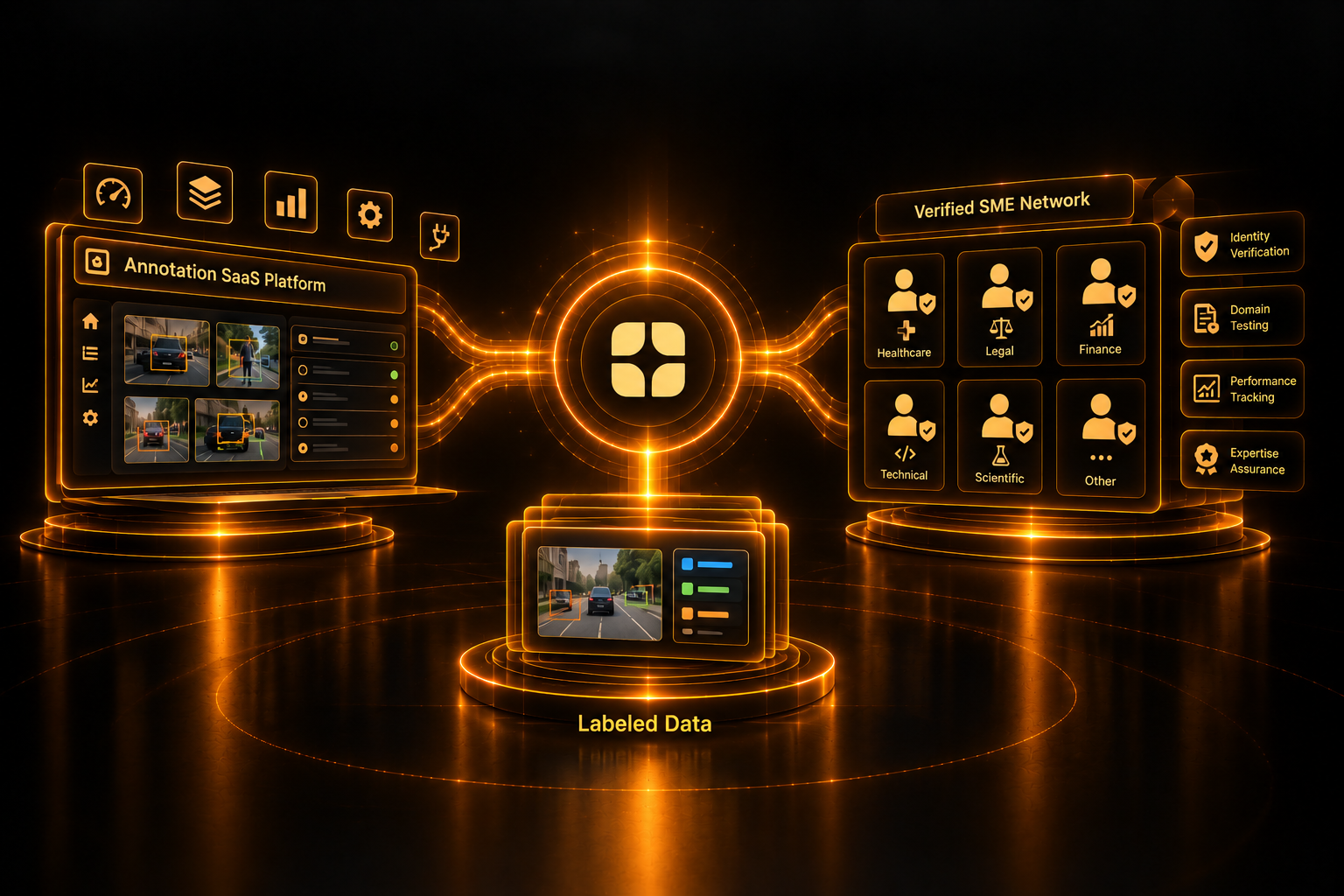
Buying an annotation SaaS platform feels like a complete solution. It comes with dashboards, task queues, quality metrics, and integrations ready to go. For a lot of enterprise buyers, signing up for a tool feels like solving the data labeling problem in one step.
It isn't. The gap usually shows up a few weeks after onboarding, not during the sales demo. A platform can organize work beautifully. It cannot, by itself, produce a single accurate label.
This post looks at the gap between buying annotation software and actually getting labeled data, and why an enterprise AI data buying guide needs to treat these as two separate decisions, not one.
An annotation SaaS platform is, at its core, task management software built for labeling work. It assigns items to be labeled, tracks progress, applies quality scoring rules, and exports the finished data in a usable format.
What most of these platforms don't include, by design, is the workforce that actually does the labeling. The software manages the process. It doesn't supply the people. That distinction sounds obvious once stated directly, but it's easy to miss when a product demo focuses entirely on the interface and none of it on who will actually be doing the work.
This is where a lot of enterprise buyers get caught off guard. A company licenses a platform expecting a complete annotation solution, then discovers that sourcing, vetting, training, and managing annotators is still entirely their own responsibility.
For simple, high-volume tasks, this gap is manageable. A company can post the work, recruit general contributors, and get reasonable results without much specialized oversight.
The gap becomes a real problem the moment the data requires domain knowledge. A platform can route a medical document to someone, but it has no way of confirming that person actually understands clinical terminology. It can flag disagreement between two annotators, but it can't explain which one was actually right in a complex legal or technical edge case.
Buying the software doesn't remove this burden. It just moves it upstream; now the enterprise has to build and manage a specialized workforce, in addition to running the platform.
The tool-without-talent gap barely matters for simple classification tasks. It matters enormously for the kind of data increasingly driving serious AI projects: healthcare, legal, finance, and other fields where a wrong label carries real consequences.
In these domains, the actual bottleneck was never the software interface. It was finding, verifying, and managing people with real subject-matter expertise, then making sure their judgment gets applied consistently across thousands of examples.
A platform with excellent task-routing logic still can't answer the question that matters most: is the person doing this label actually qualified to do it correctly?
A verified SME network approaches the problem from the opposite direction. Instead of starting with software and leaving workforce sourcing to the client, it starts with verified, domain-qualified people and builds the process around them.
This typically includes identity and background verification before anyone touches live data, domain-specific testing to confirm real expertise rather than self-reported skills, and ongoing performance tracking tied to actual subject-matter accuracy, not just task completion speed.
The difference isn't cosmetic. A platform asks, "Did this task get completed?" A verified SME network asks, "Was this task completed correctly, by someone qualified to judge that?" Those are very different questions, and only one of them actually protects data quality.
Neither model is universally better. The right choice depends heavily on what's actually being labeled.
Before choosing either model, a few direct questions help clarify what's actually needed:
Most procurement conversations around annotation default to comparing software features and pricing tiers. Far fewer ask the more fundamental question: does this purchase include the actual expertise our data requires, or does it just organize work for expertise we still have to find ourselves?
This distinction matters more as AI use cases move into increasingly specialized, high-stakes territory. A tool that worked fine for simple labeling a few years ago may be a poor fit for the domain-sensitive data now driving serious enterprise AI projects, not because the software got worse, but because the nature of the work changed.
An annotation SaaS platform and a verified SME network solve two different problems that often get confused for the same one. A platform organizes labeling work. A verified network supplies the qualified people who actually do it correctly.
For simple, low-stakes data, a self-managed platform can work well. For specialized, high-stakes data, the real question isn't which software has the better dashboard. It's whether the people behind that dashboard are actually qualified to get the label right in the first place.
A: An annotation SaaS platform is software that manages labeling tasks, tracks progress, and organizes workflow, while a verified SME network supplies domain-qualified, background-checked annotators who actually perform the labeling with real subject-matter expertise.
A: An annotation software platform isn't enough for specialized data because it manages task assignment and tracking but doesn't verify whether the person doing the labeling actually understands the subject matter, which matters significantly for fields like healthcare, legal, or finance.
A: "Tool without talent" refers to the gap where a company licenses annotation software expecting a complete labeling solution, only to discover that sourcing, vetting, and managing qualified annotators remains entirely their own responsibility.
A: A self-managed annotation SaaS platform is a good fit for simple, high-volume, low-ambiguity labeling tasks, especially when a company already has the internal capacity to recruit and manage its own contributor workforce.
A: Enterprises should ask who is responsible for sourcing and managing annotators, whether their data requires general attentiveness or real subject-matter expertise, and how contributor qualifications would actually be verified before relying on the data for model training.