Reinforcement learning from human feedback earned its reputation almost entirely through chatbots. It's the technique most credited with turning raw, sometimes erratic language models into the helpful, well-behaved conversational assistants that defined the last several years of consumer AI. Ask two people to compare two chatbot responses, train a reward model on which one they preferred, and use that signal to nudge the underlying model toward more helpful, appropriately cautious, better-calibrated behavior. That basic loop became one of the most consequential techniques in modern AI development.
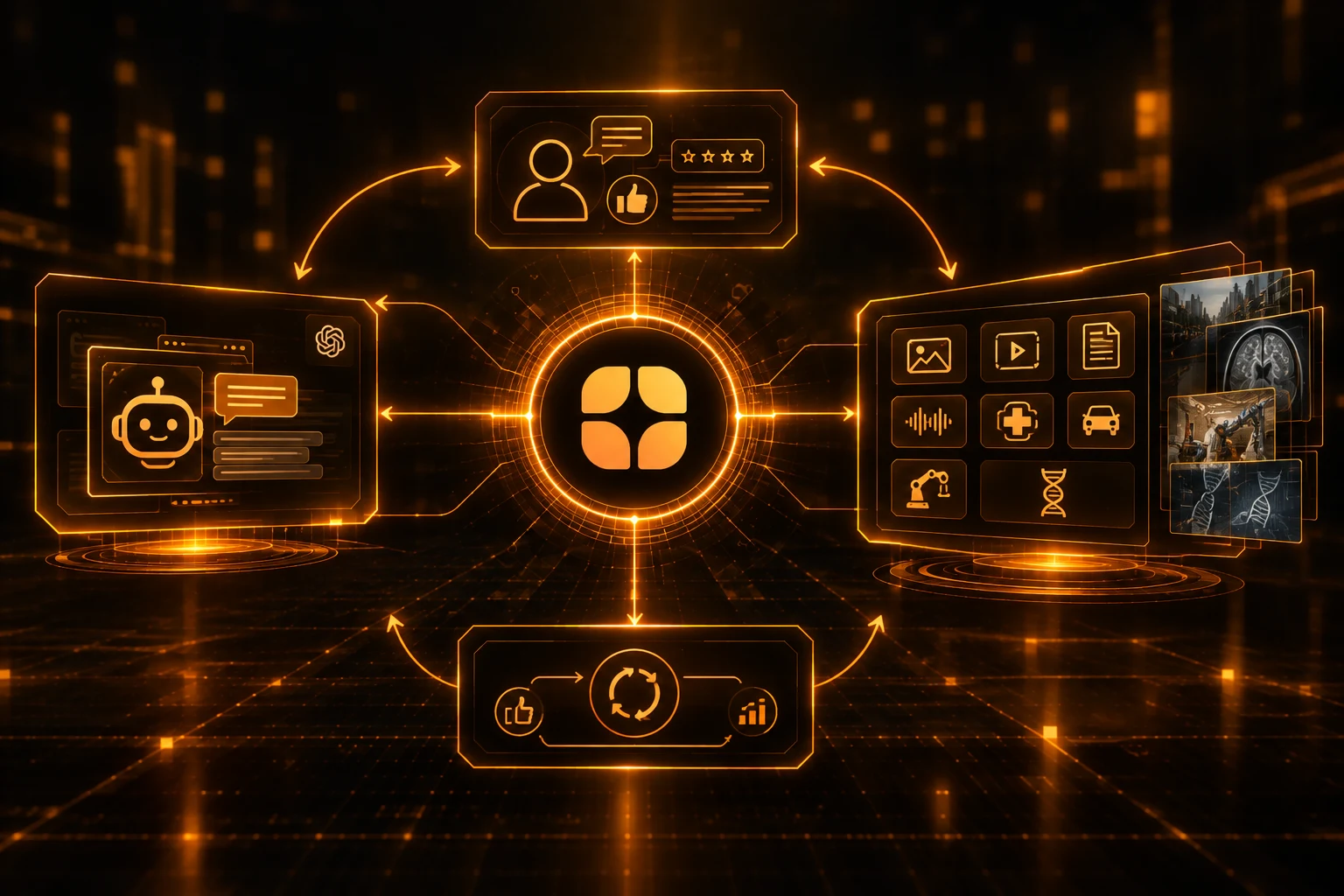
But RLHF was never inherently a chatbot-specific technique. It's a general method for aligning a model's behavior with human preferences using comparative feedback, and in 2026, that general applicability is becoming much more visible. RLHF, and the broader family of preference-based alignment techniques it spawned, is showing up in agentic AI, robotics, specialized enterprise applications, and evaluation processes that look meaningfully different from the pairwise chat response comparisons that made the technique famous. Understanding where RLHF is actually headed matters for any organization thinking seriously about how to align increasingly capable, increasingly autonomous AI systems with what people actually want from them.
The original RLHF loop is relatively simple to describe. A model generates two or more candidate responses to the same prompt. Human raters compare them and indicate a preference. That preference data trains a separate reward model, which learns to predict which of two outputs a person would likely prefer. The original language model is then fine-tuned using reinforcement learning, guided by this reward model, to produce outputs more consistently aligned with what raters actually preferred.
This worked well for chatbots specifically because the unit of evaluation matched the unit of interaction cleanly: a single response to a single prompt, judged largely on its own merits, helpfulness, accuracy, tone, appropriate caution. Human raters could reasonably evaluate this kind of isolated comparison quickly and consistently, making it practical to collect the large volumes of preference data RLHF depends on.
Agentic AI doesn't produce a single evaluable output. An AI agent completing a multi-step task generates an entire sequence of decisions, tool calls, and intermediate results, not a single response that can be cleanly compared against an alternative. Applying standard RLHF's pairwise response comparison to this kind of extended, multi-step behavior misses most of what actually matters, whether the agent was efficient, whether it took appropriate caution around irreversible actions, whether it recovered gracefully from an error partway through.
Robotics and physical AI involve continuous, embodied behavior. A robot's action isn't a discrete text response; it's a continuous physical trajectory unfolding over time, often with safety and physical consequence considerations that a simple preference comparison between two isolated outputs doesn't naturally capture.
Specialized enterprise applications need domain-grounded preference, not general helpfulness. A generalist rater's sense of a "better" response works reasonably well for general chatbot helpfulness, but it doesn't transfer to judging whether a legal analysis correctly weighed a jurisdictional nuance, or whether a clinical summary appropriately flagged a finding, judgments that require genuine domain expertise the original RLHF rater pool was never built around.
RLHF for agentic behavior, evaluating full trajectories rather than single turns. Rather than comparing two isolated responses, emerging approaches have raters evaluate entire action sequences, weighing efficiency, safety, and appropriate escalation to a human, alongside whether the final outcome was correct. This shift changes both what raters are asked to judge and what the resulting reward signal actually teaches the model, moving from "which response sounds better" to "which overall approach to this task was better."
Process-level reward modeling, not just outcome-level. Rather than only rewarding a correct final answer, this approach evaluates and rewards the quality of intermediate reasoning and decision-making steps along the way, closely related to reasoning trace annotation, and particularly valuable for teaching models sound processes rather than just pattern-matching toward plausible-looking final answers.
RLHF combined with verifiable, outcome-grounded reward signals. For tasks where correctness can be objectively verified, did the generated code actually run successfully, was a mathematical proof actually valid, reward signals increasingly combine human preference judgment with automated, verifiable correctness checks, reducing reliance on subjective human judgment alone for tasks where an objective answer exists.
Domain-specific RLHF using genuinely qualified raters. For enterprise and specialized applications, preference data collection is increasingly built around raters with real domain qualifications, legal professionals evaluating legal reasoning quality, clinicians evaluating clinical summary accuracy, rather than general-purpose raters applying broad helpfulness criteria to highly specialized content.
RLHF for physical and embodied AI. As robotics and physical AI systems mature, preference-based feedback is being adapted to evaluate physical behavior, comparing different approaches to a manipulation task or navigation decision, and incorporating safety and appropriate caution considerations specific to acting in the physical world rather than only generating text.
Constitutional and rule-guided approaches alongside pure preference learning. Rather than relying solely on comparative human preference, some approaches increasingly combine RLHF with explicit rules or principles a model should follow, using human feedback to refine and calibrate adherence to these principles rather than deriving behavior purely from preference comparisons alone.
Multi-stakeholder and multi-objective preference modeling. As AI systems serve increasingly diverse users and use cases, some approaches are exploring how to incorporate preferences from multiple, sometimes competing perspectives, rather than assuming a single, uniform notion of a "better" response applies universally across every context and user.
Each of these directions changes what the underlying training data collection process actually needs to look like, not just how the resulting reward signal gets used in model training.
Raters need to evaluate longer, more complex units of work. Comparing full agentic trajectories or extended physical action sequences takes considerably more rater time and cognitive effort than comparing two short chat responses, requiring different tooling, different rater training, and different quality assurance processes than standard RLHF data collection was built around.
Domain expertise becomes a data collection bottleneck. As preference data collection moves into specialized enterprise and technical domains, the pool of qualified raters shrinks considerably compared to the broad pool available for general chatbot preference collection, making genuine domain-expert RLHF data collection meaningfully more resource-intensive to scale.
Consistency measurement becomes more complex, not less important. Evaluating agreement between raters judging complex, multi-step trajectories or specialized technical content requires more sophisticated consistency measurement than simple binary preference agreement on isolated chat responses, but remains just as essential for trusting the resulting reward signal.
Combining human preference with automated verification requires new infrastructure. Building pipelines that can objectively verify certain outcomes, like code execution or mathematical correctness, alongside collecting human preference judgment for more subjective qualities, requires data infrastructure that standard chat-focused RLHF pipelines weren't originally built to support.
Don't assume standard RLHF data collection transfers directly to agentic or specialized applications. Organizations building agentic AI, robotics applications, or specialized enterprise tools need preference data collection processes built specifically around these use cases, not simply adapted chat-style pairwise comparison.
Invest in genuinely qualified raters for domain-specific preference data. Just as with annotation more broadly, the quality of RLHF preference data for specialized applications depends heavily on the raters actually having relevant domain expertise, not general judgment applied to specialized content.
Plan for the increased complexity of trajectory-level and process-level evaluation. Building the tooling, guidelines, and rater training needed to evaluate extended, multi-step behavior takes meaningfully more investment than standard chat response comparison, and organizations should budget accordingly rather than assuming existing RLHF infrastructure transfers directly.
Combine human preference with verifiable correctness where possible. For tasks where objective verification is feasible, building this into the data pipeline alongside human preference judgment can improve reward signal quality and reduce dependence on subjective judgment alone for exactly the kinds of tasks where an objectively correct answer actually exists.
RLHF's expansion beyond chatbots in 2026 reflects a broader truth about the technique itself: it was always a general method for aligning model behavior with human judgment, and its chatbot-era form, pairwise comparison of isolated text responses, was simply the version that matched the first major wave of AI products well enough to become the default. As AI systems take on multi-step agentic tasks, physical embodiment, and specialized enterprise work, RLHF is evolving to match, moving toward trajectory-level evaluation, process-level reward modeling, domain-qualified raters, and hybrid approaches combining human preference with verifiable correctness.
For organizations building AI systems that go meaningfully beyond single-turn chat, treating RLHF data collection as a solved, transferable problem risks building alignment infrastructure that doesn't actually match what these newer systems need to be judged on. Getting RLHF right in 2026 increasingly means building it specifically for the task at hand, not assuming the chatbot-era version of the technique automatically generalizes.
RLHF, reinforcement learning from human feedback, is a technique that trains a reward model on human preference comparisons between candidate outputs, then uses that reward model to fine-tune an underlying AI model. It became closely associated with chatbots because comparing two isolated text responses to the same prompt was a practical, scalable way to collect the preference data it depends on.
Because agentic AI produces extended, multi-step sequences of decisions and actions rather than a single evaluable response, and standard pairwise response comparison misses important qualities like efficiency, safety, and appropriate escalation that only become visible when evaluating a full task trajectory.
It's an approach that evaluates and rewards the quality of intermediate reasoning and decision-making steps along the way to a conclusion, rather than only rewarding a correct final answer, helping models learn sound processes rather than just pattern-matching toward plausible final outputs.
Preference-based feedback is being adapted to evaluate physical behavior and action sequences, comparing different approaches to tasks like manipulation or navigation, and incorporating safety and appropriate caution considerations specific to acting in the physical world.
Because judging whether a specialized output, such as a legal analysis or clinical summary, is actually correct requires genuine subject-matter expertise that general-purpose raters, however good their broad judgment, typically don't have.