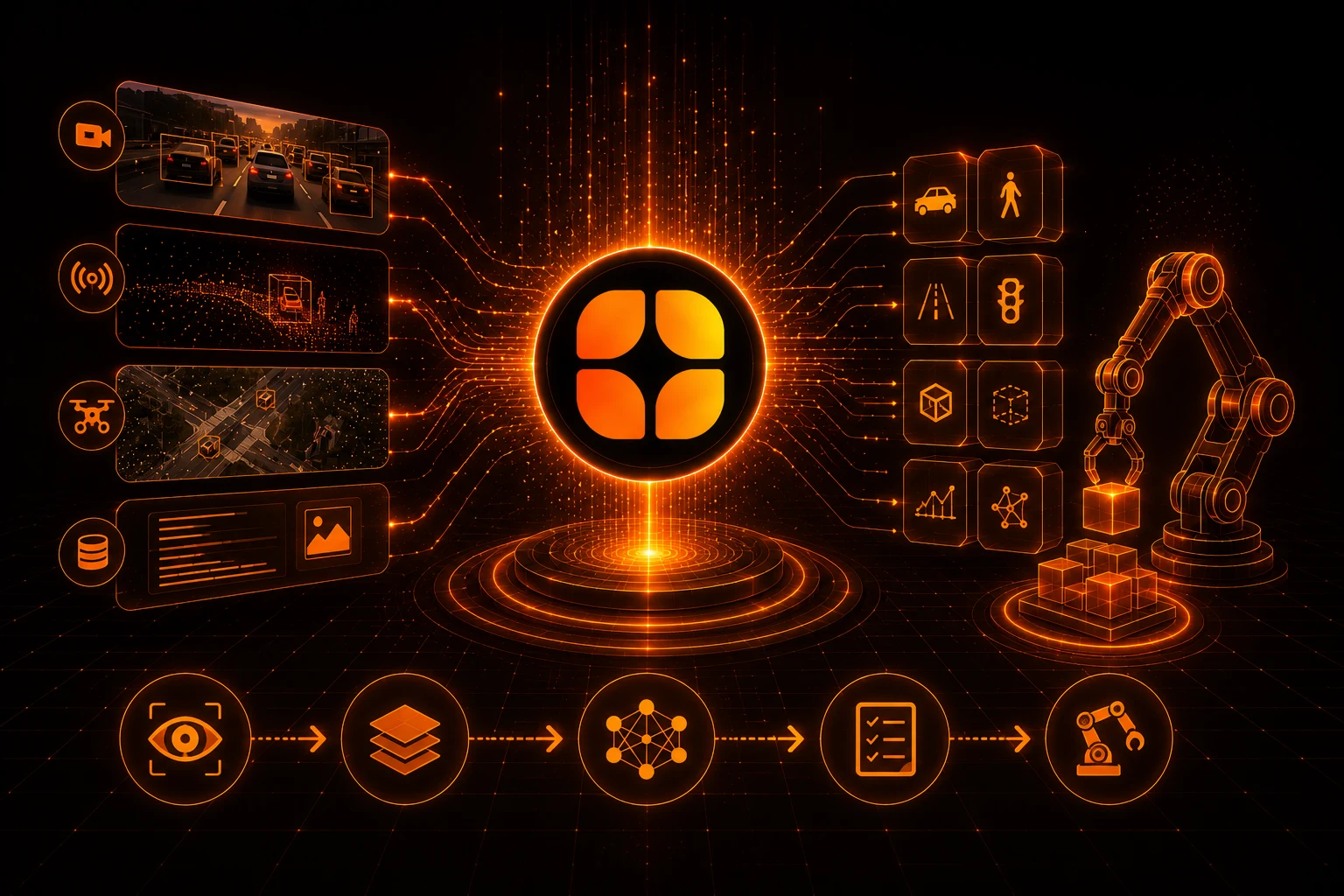
For the last few years, AI progress has followed a comfortable pattern: scrape the internet, train a large model, watch it get better at almost everything. Language models learned to write and reason from trillions of words that already existed. Vision models learned to recognize and describe images from billions of captioned photos that already existed. In both cases, the raw material for training was sitting on the internet, free for the taking, generated by humans going about their normal digital lives.
Physical AI does not get that shortcut.
A warehouse robot, a surgical assistant, a humanoid in a factory, or a self-driving vehicle doesn't just need to recognize a wrench or describe a hallway. It needs to reach for the wrench with the right trajectory, apply the right amount of force, adjust mid-motion when the wrench slips, and know when to stop because something has gone wrong. That chain from "I see a wrench" to "I am now holding the wrench correctly" is the layer that current internet-scale data simply does not cover. Images and video show what happened. They rarely show the control signals, forces, and corrections that made it happen.
This is the missing layer between vision and action, and it's quickly becoming the central bottleneck in physical AI development.
Vision-language models (VLMs) and their more advanced cousins, vision-language-action (VLA) models, have made real progress toward closing this gap. A modern VLA model can take a camera feed and a natural-language instruction and output something resembling a motor command. That's a genuine breakthrough it means a single model can plan and act instead of requiring a separate perception stack bolted onto a separate control stack.
But a model architecture that can output actions is not the same thing as a model that has seen enough correctly labeled actions to output good ones. The industry has largely solved the "can a model connect perception to action" question. It has not solved the "where does the model get enough high-quality examples of that connection" question. Estimates circulating among robotics researchers put the total volume of high-quality, real-world robotic interaction data in the hundreds of thousands of hours a rounding error compared to the billions of hours that would be needed for anything approaching general-purpose physical competence. Text had trillions of naturally occurring words to learn from. Physical interaction has almost none, because nobody was walking around recording their joint torques, grip forces, and contact points for the last twenty years.
That's the structural reason vision-language fluency doesn't translate into physical competence on its own. The model can describe the scene beautifully and still fail to close its fingers around the object at the right moment.
"Physical AI training data" is not one thing. It's a stack of distinct data types, each capturing a different part of the perception-to-action chain, and each requiring a different collection and annotation approach.
Demonstration data. Human teleoperation, kinesthetic teaching, or motion-capture sessions where a person performs a task while a robot or sensor rig records the full trajectory joint angles, end-effector position, gripper state, and timing synchronized with video. This is the closest thing physical AI has to a labeled dataset, and it's expensive to produce because it requires physical hardware, trained operators, and careful synchronization between multiple data streams.
Action-grounded video. Ordinary video of humans doing tasks (cooking, assembling, cleaning) becomes useful for physical AI only once it's annotated with structured labels: object identities and poses frame by frame, contact events, grasp types, force estimates, and task segmentation into sub-steps. Raw egocentric video is abundant; correctly annotated egocentric video, tied to an action ontology a robot can actually use, is not.
Proprioceptive and force-torque data. Cameras tell a model what things look like. They don't tell it how hard to squeeze, how much resistance to expect from a heavier-than-it-looks box, or when a joint is about to stall. This sensor data has to be time-aligned with vision and language labels so a model can learn the correlation between "the object looks like this" and "the object behaves like this when touched."
Failure and recovery data. Most usable robotics datasets over-represent success. A model trained only on clean demonstrations has no idea what to do when a grasp slips, an object rolls out of reach, or a door doesn't open on the first push. Deliberately collected and annotated failure cases including the corrective actions that followed them are disproportionately valuable and disproportionately rare, because nobody wants to publish their mistakes.
Simulation-to-real bridging data. Physics simulators can generate enormous volumes of synthetic trajectories cheaply, and newer world-model approaches are making synthetic data dramatically more useful for training. But simulated environments still diverge from the real world in friction, lighting, material deformation, and sensor noise. Closing that gap requires paired sim/real datasets and careful human evaluation of where simulated dynamics stop matching physical reality otherwise a model trained purely in simulation learns confident, physically wrong behavior.
Language-to-action grounding. VLA models need instructions like "hand me the red mug, not the blue one" mapped precisely to the correct object and motion in a scene with several plausible candidates. This requires disambiguation-aware annotation labeling not just what's correct, but what a model might confuse it with, and why.
Three characteristics make physical AI data categorically harder to annotate than text or image data.
It's multimodal and time-synchronized by nature. A single training example might combine multi-camera video, joint-state telemetry, force readings, and a natural-language task description, all of which must line up to the same fraction of a second. An annotation error in timing alignment is often worse than no annotation at all, because it teaches the model an incorrect cause-and-effect relationship.
It's embodiment-specific. A grasping strategy that works for a two-finger gripper doesn't transfer cleanly to a five-fingered hand. Annotators and data pipelines need to understand the physical constraints of the specific robot or task the data is destined for, not just label "the robot picked up the cup."
Edge cases dominate the value. In manufacturing, logistics, and autonomous driving, the failure modes that actually matter a part jammed at a slightly wrong angle, a pedestrian stepping out from behind a parked truck are rare by definition and expensive to capture in the real world. Generating and correctly annotating these long-tail scenarios, whether captured live or built through simulation and augmentation, is where most of the real engineering effort in a physical AI data pipeline goes.
Producing this missing layer at scale isn't a matter of hiring more people to click labels faster. It requires a pipeline built specifically around physical grounding:
This is a fundamentally different discipline from labeling images for object detection or annotating documents for a language model. It sits at the intersection of data annotation, robotics domain knowledge, and physical common sense which is exactly why so few data partners are set up to do it well.
The industry narrative around physical AI has understandably focused on the model side: bigger world models, faster simulators, more capable vision-language-action architectures. All of that progress is real. But architecture without the right training material behind it produces robots that look impressive in a demo reel and fall apart the moment conditions deviate even slightly from what they've seen.
The organizations that will actually ship reliable physical AI systems in warehouses, factories, vehicles, and eventually homes are the ones treating this missing layer as seriously as they treat model architecture. That means investing in demonstration collection, action-grounded annotation, force and proprioceptive labeling, and deliberate edge-case sourcing as a core part of the development pipeline, not an afterthought bolted on after the model already exists.
Vision tells a system what the world looks like. Language tells it what to do. Only carefully built physical training data teaches it how to actually do it safely, precisely, and reliably enough to trust with real objects, real environments, and real consequences.
Building a physical AI system and need action-grounded training data at scale? Globik AI's annotation teams specialize in the multimodal, physically literate labeling that vision-language-action models require. Talk to our team →
Physical AI refers to AI systems that don't just perceive or generate content, but perceive, reason, and act in the real world through a physical body robots, autonomous vehicles, and other embodied machines. It typically combines vision, language understanding, and motor control in a single system.
Language and vision models are largely trained on data that already existed on the internet text and images humans produced anyway. Physical AI needs synchronized, multimodal data (video, joint telemetry, force readings, language instructions) tied to real motor actions, which almost never exists naturally and has to be deliberately captured or generated.
Video shows what happened but not the underlying control signals the forces, contact points, and corrective adjustments that produced it. Without that grounding, a model can describe a scene accurately and still fail to physically execute the action correctly.
It's data where a physical action (a grasp, a push, a steering adjustment) is explicitly labeled and time-aligned with the sensory input that preceded it video, proprioception, and language so a model can learn the actual cause-and-effect relationship, not just correlation.
Most collected robotics data over-represents clean, successful attempts. Real-world deployment requires models that can recognize and recover from slips, jams, and unexpected obstacles, so deliberately captured and annotated failure-and-recovery sequences carry outsized training value relative to how common they are in typical datasets.
Simulation is essential for generating volume cheaply, especially for rare or dangerous edge cases, but simulated physics still diverges from real-world friction, material behavior, and sensor noise. Most reliable pipelines pair simulated data with real-world validation to catch where the two disagree.