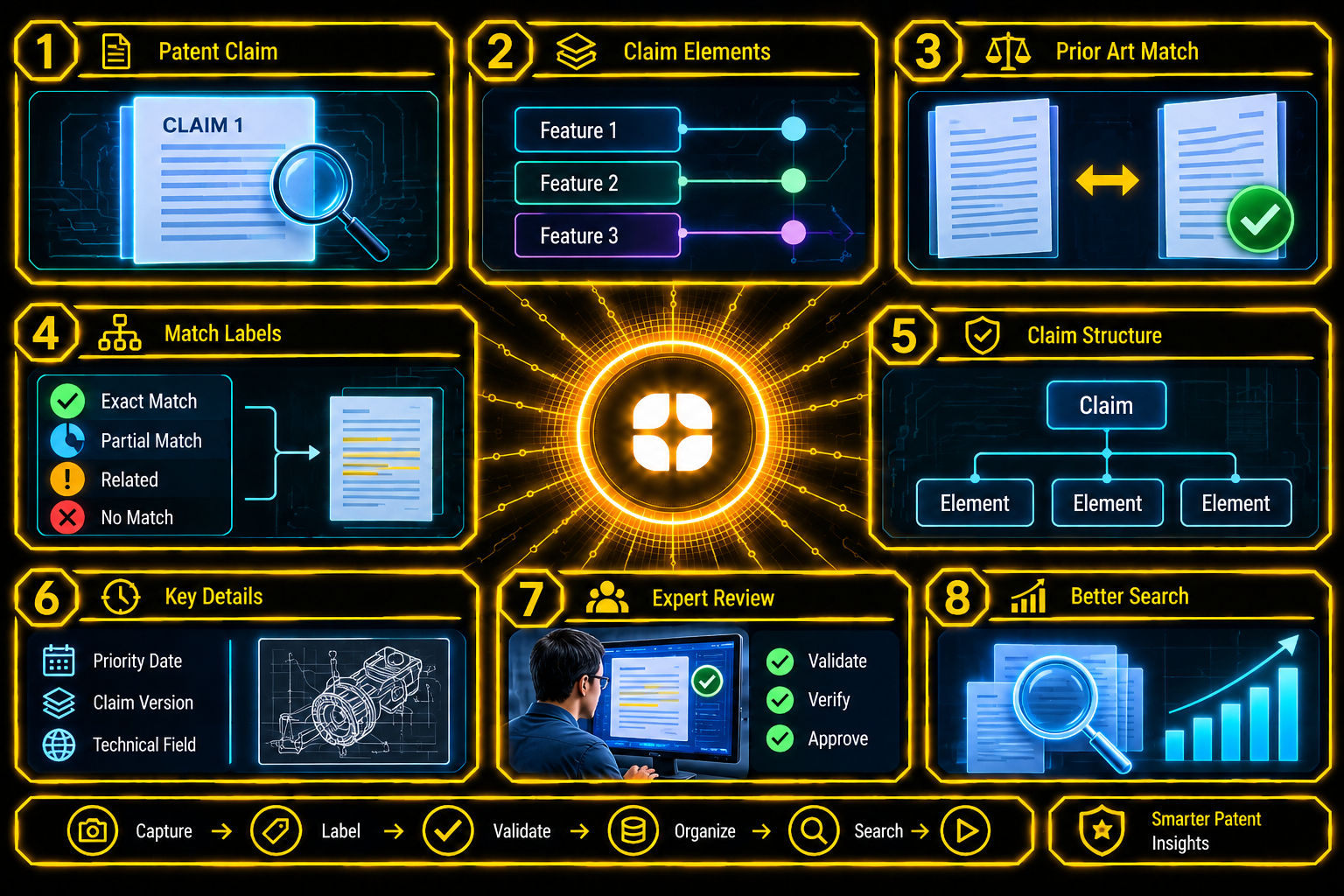
A patent claim is a single long sentence that defines what an invention covers. Before a patent is granted, or when one is challenged, someone must check whether earlier documents already describe the same thing. That earlier material is called prior art, and searching it by hand can mean reading hundreds of pages for one claim.
AI can speed up that search, but only if it learns from carefully labeled examples. Good patent claim annotation means breaking claims into parts and linking each part to matching evidence, the same way every time. This post explains what the work covers, why it is hard, and what legal AI training data needs to get right.
Annotation for patent work usually has four parts:
Models trained on these labels can suggest relevant references, highlight the passage that matches each element, and show which parts of a claim are still uncovered.
Claims are written to be precise, and they read that way.
Annotators need rules for each of these. Without them, two people split the same claim in two ways, and the model learns the disagreement.
An element is one feature the claim requires, such as a part, a step, or a relationship between parts. The guide should say where to cut. Does a part and its property count as one element or two? Pick one rule, give examples, and have two reviewers split the same claims until they agree.
Dependent claims need care too. The elements of the claim they refer to carry over, so labelers should link them instead of copying the text. Everything downstream depends on stable elements, since a match is judged element by element.
Claim labeling reads one document, the claim, and asks what it requires. Errors come from long sentences, dependencies, and defined terms. Evidence labeling reads a second document and asks whether it shows the same thing. Errors come from different wording, figures that show what the text does not, and passages that mention a feature without teaching it.
A single guide for both would blur these differences. Each needs its own definitions, examples, and reviewers.
A match is rarely a word-for-word copy. A reference may describe the same feature in different words, or show it only in a drawing. Figures matter as well, since a drawing may show a feature the text never names. Labelers should check both before marking “no match.”
A useful match scale has a few clear levels: exact match, partial match, related but different, and no match. Each level needs a definition and examples, and the label should record the exact passage or figure used. Where an element is met only by combining two passages, the guide should say how to mark it.
Prior art only counts if it came before the date that matters, so each reference should carry its publication date, and each claim its version. Related patents in one family may repeat text, so avoid counting one disclosure twice.
Most passages do not match, and exact matches are rare. Count examples at each match level, collect more of the thin ones early, and include several technical fields. Keep all documents from one family on one side of the train/test split, or scores will look better than they are.
Some passages cannot support a clear match. Give annotators an “unclear” option and send doubtful cases to a specialist. A false match can hide a real gap, and a missed match can waste a search, so the rules should say how each is handled. Our guide to case law citation and treatment annotation covers a related need to tie each legal label to the exact supporting text.
People with patent and technical training know how wording changes scope, how dependent claims build on others, and how to tell a real disclosure from a passing mention. Reviewers who know the technical field also recognize when two different terms mean the same thing.
Specialists write the element rules, set the match scale, and review hard cases. This reflects Globik AI’s approach of using verified domain experts for work that depends on judgment, where a generalist would be guessing.
Before starting a patent project, settle these points:
A patent claim is only as useful as the care taken to read it, and a match is only as good as its evidence. Strong patent claim annotation uses stable element rules, a clear match scale, marked evidence, and reviewers with patent and technical knowledge. With that foundation, models can help teams search prior art faster and see where a claim stands.
It is the labeling of patent claims so AI can identify their elements and structure. Annotators split each claim into features and follow written rules so the same claim is always divided the same way.
It is linking each claim element to passages in earlier documents that may show the same feature. Each link carries a match level and the exact evidence, so reviewers can check it.
It is one feature a claim requires, such as a part, a step, or a relationship between parts. Matches are judged element by element, so stable splitting rules matter.
Claims are long, use defined terms, and depend on earlier claims. Small wording changes can alter scope, so annotators need clear rules and expert review.
Specialists understand how wording affects scope and how to judge a real disclosure. They write clear element and match rules and review doubtful cases.