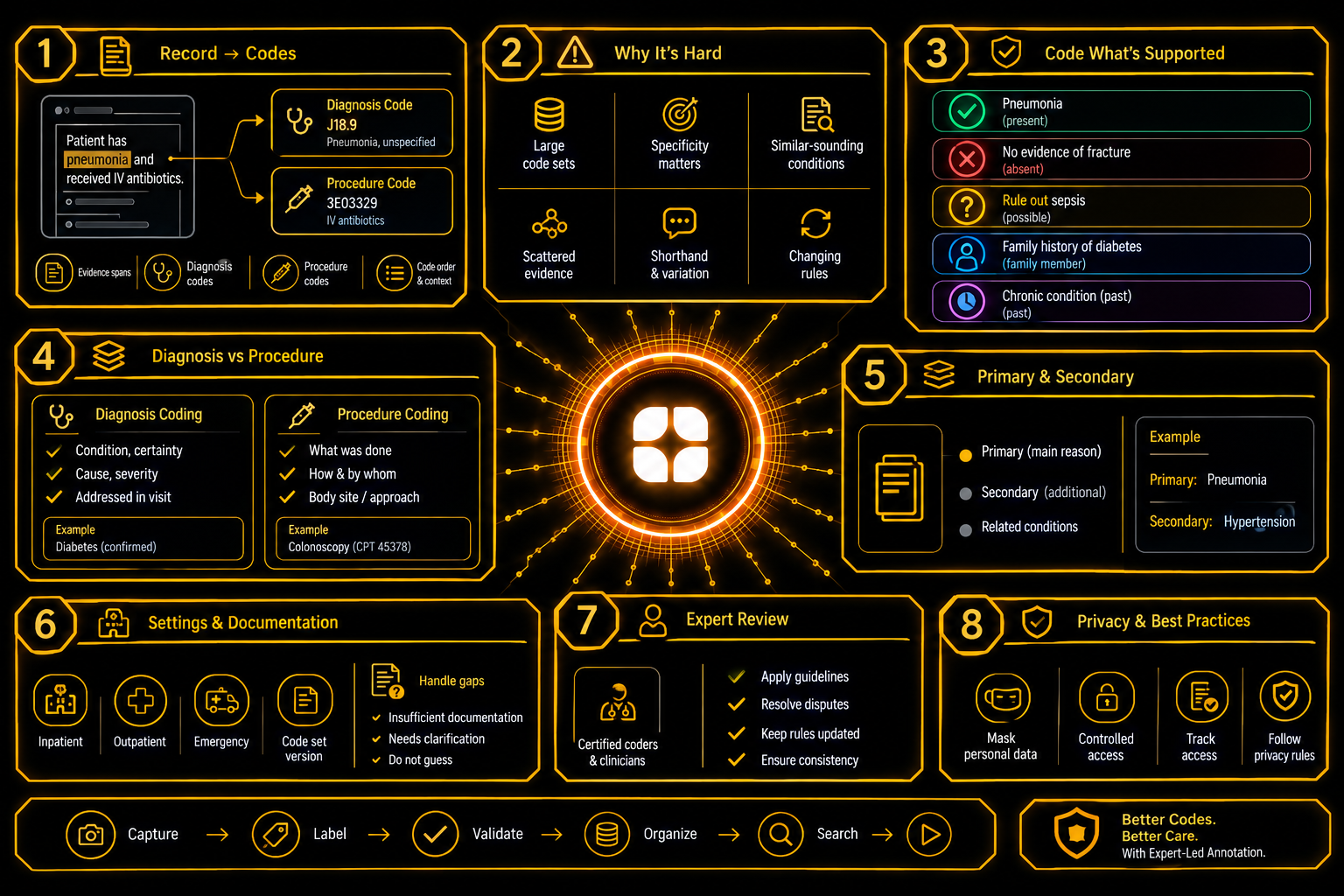
Every hospital visit ends with a record, and every record must become a set of codes. Diagnosis codes say what was wrong with the patient. Procedure codes say what was done. Those codes decide how a claim is paid, how care is measured, and how diseases are tracked across a population. Today, trained coders read each chart and assign them by hand.
AI can speed up this work, but only if it learns from charts that were coded correctly. That makes medical coding annotation a careful task. This post explains what the work covers, why it is hard, and what healthcare AI training data needs to get right.
Medical coding annotation links parts of a clinical record to the codes they support. It usually includes four layers:
Models trained on these labels can suggest codes to a human coder, flag charts that look incomplete, and check a claim against its source note. The aim is to support coders, not to replace their judgment.
Turning clinical documentation to codes is not a lookup task. A note rarely says “assign this code.” It describes a patient in natural language, and the coder must decide what the words mean under the coding rules.
The most important rule in coding is that a code must be backed by the documentation. If the note does not say it, the code should not be assigned, even if the patient probably had the condition.
Annotators must separate several cases that look similar in text:
These are the same signals that matter in clinical text labeling. Our guide to clinical note annotation for EHR NLP covers negation, who a finding belongs to, and timelines, and coding labels depend on getting them right first.
Diagnosis coding and procedure coding look alike but need different labeling rules.
Diagnosis coding asks what condition the patient had and how certain the note is. Labelers focus on wording about certainty, cause, severity, and whether the condition was addressed during the visit. A condition that is only mentioned in passing may not qualify.
Procedure coding asks what was actually done, how, and by whom. Labelers focus on the method, the body site, and the approach. A note may describe a procedure in detail yet only part of it may be coded, and a planned procedure that was not performed should not be coded at all.
One guide for both would blur these rules. Each needs its own examples and its own reviewers.
Most visits involve more than one condition. The coder must decide which one is the main reason for the visit and which others add context. The choice affects payment and statistics, so it is a labeling decision with real consequences.
Guidelines should state how the primary code is chosen and how related conditions are linked. They should also say what to do when two coders could reasonably choose different primary codes. In those cases a reviewer settles the case and records the reason, so the same question is answered the same way next time.
Coding rules differ between care settings. An inpatient stay, an outpatient clinic visit, an emergency visit, and a doctor’s own billing may each follow different conventions. The same note might support different codes depending on where the care took place.
Every record should therefore carry its setting and the code set version in use. Mixing settings or versions in one dataset gives the model rules that contradict each other.
Charts are often incomplete. A diagnosis may be implied but never stated. A procedure note may lack a key detail. Coders sometimes query the doctor for clarification, but annotation datasets usually cannot.
Annotators need a rule for these cases. A good workflow lets them mark a record as “documentation insufficient” or “needs clarification” instead of picking the closest code. Those records can then be reviewed by an expert, or kept in a separate group so the team can see how often documentation gaps occur.
Clinical records contain names, dates, and other personal details. Teams should decide early which details are masked, who may view raw records, and how access is logged. Coding labels should refer to codes and evidence spans, not to personal facts about the patient.
Certified coders and clinicians read charts differently from general annotators. They know how a diagnosis statement differs from a passing mention, how guidelines handle uncertain conditions, and why specificity changes the code. They can also spot when a note supports a code and when it only hints at one.
Specialists write the labeling rules, settle disputes on primary codes, and keep guidelines current as code sets change. This reflects Globik AI’s approach of using verified domain experts for work that depends on judgment, where a generalist would be guessing.
Before starting a medical coding project, settle these points:
A code is a claim about a patient, and it must be supported by the words in the chart. Strong medical coding annotation uses clear evidence rules, careful handling of certainty and specificity, settings-aware guidelines, and reviewers who are trained coders. With that foundation, AI can help coders work faster while the final judgment stays with people.
It is the labeling of clinical records so AI can link note text to diagnosis and procedure codes. Annotators mark the evidence for each code, which teaches models how documentation supports coding decisions.
Code sets are very large, notes use shorthand, and evidence is often spread across a chart. Small details such as side, stage, or certainty can change the correct code.
It depends on the care setting and the coding rules in use. Annotators need written guidance for terms such as “possible” or “rule out,” or labels will vary between people.
Annotators should flag the record as insufficient or needing clarification instead of guessing a code. Expert review then decides whether it is used, corrected, or set aside.
Certified coders and clinicians understand coding guidelines, specificity, and primary code rules. They write consistent labeling rules and review hard cases, making the training data more reliable.