An enterprise team fine-tunes or deploys a large language model, runs it against standard public benchmarks, sees strong scores, and greenlights production deployment. Weeks later, the model is confidently producing subtly wrong answers on exactly the specialized tasks the business actually needed it for, a misclassified contract risk, an inaccurate clinical summary, a miscalculated financial figure, none of which the benchmark suite ever tested for. This gap between benchmark performance and real-world reliability is one of the most consistent, costly patterns in enterprise AI deployment, and it traces back almost entirely to a single root cause: evaluation built without genuine domain expertise behind it.
Public benchmarks are built to measure general capability across broad, publicly available tasks. They're useful for comparing models at a high level, but they were never designed to answer the specific question an enterprise actually needs answered: does this model perform reliably on our specific domain, our specific data, and our specific definition of a correct answer. Answering that question requires evaluation built and reviewed by people who actually understand the domain, not just people who can read the model's output and judge whether it sounds reasonable. This guide covers why domain-expert LLM evaluation matters, what it actually involves, and how enterprise teams can build it into their deployment process.
Public benchmarks test general capability, not domain-specific correctness. Standard benchmarks are built around broadly applicable tasks, general reasoning, common knowledge, coding ability, that don't reflect the specific terminology, edge cases, and correctness standards of a specialized enterprise domain like insurance underwriting, clinical documentation, or regulatory compliance.
Benchmark contamination undermines score reliability. Large language models are frequently trained on data that overlaps with public benchmark content, meaning strong benchmark performance can partly reflect memorization rather than genuine generalizable capability, a gap that only becomes apparent once a model faces genuinely novel, domain-specific tasks it wasn't implicitly trained on.
Generic quality raters can't judge specialized correctness. Many evaluation pipelines rely on general-purpose human raters, or even other language models, to judge output quality. This works reasonably well for conversational fluency and general helpfulness, but it fails for tasks where correctness depends on specialized knowledge a generalist rater simply doesn't have.
Aggregate scores hide domain-specific failure patterns. A model can post strong overall accuracy while consistently failing on a specific, high-stakes subcategory relevant to a particular business, a pattern that only becomes visible through evaluation designed specifically around that subcategory, not a broad, aggregate score.
Enterprise correctness standards are often stricter and more specific than general benchmarks assume. What counts as an acceptable answer in a regulated, high-stakes business context often involves precision requirements, compliance considerations, and risk tolerances that general benchmark criteria were never built to capture.
Task-specific evaluation criteria built with domain input. Rather than applying a generic quality rubric, domain-expert evaluation starts with criteria defined by people who understand what a genuinely correct, complete, and appropriately cautious answer looks like within the specific enterprise context.
Expert review of model outputs against real business scenarios. This involves evaluating model responses to actual, representative examples of the tasks a business needs the model to perform, reviewed by professionals with genuine expertise in that specific domain, rather than generic example prompts pulled from a public dataset.
Error categorization by domain-relevant failure type. Rather than a single pass or fail judgment, rigorous evaluation categorizes errors by type, a factual error, a missed compliance consideration, an inappropriately confident answer to an ambiguous question, since different failure types carry different levels of risk and require different fixes.
Edge case and adversarial evaluation informed by real domain knowledge. Domain experts are well positioned to identify the specific edge cases and challenging scenarios that matter most within their field, ones that a generic evaluation set would likely never include, providing far more targeted insight into a model's actual weaknesses.
Consistency measurement across expert evaluators. Just as with annotation more broadly, evaluation involving multiple domain expert reviewers benefits from measuring inter-rater agreement, confirming that the evaluation criteria are being applied consistently rather than reflecting one reviewer's idiosyncratic judgment.
Outcome-linked evaluation where feasible. The strongest evaluation approaches connect a model's output not just to expert judgment of plausibility, but to actual confirmed outcomes wherever possible, did a flagged risk assessment prove accurate, did a generated summary match a verified record, grounding evaluation in reality rather than expert opinion alone.
The core argument for domain-expert evaluation mirrors the argument for domain-expert training data annotation directly: a model's usefulness is capped by the quality of the judgment applied to it, whether that judgment shapes what the model learned or how its output gets assessed before deployment. An enterprise that invests heavily in expert-annotated training data but then evaluates the resulting model using generic, non-expert criteria has built a gap directly into its deployment process, one where the model may have learned genuinely well but the organization has no reliable way of confirming it, since the evaluation itself can't tell good domain-specific performance from confident-sounding but wrong output.
This connects to why inter-annotator agreement and other rigorous quality metrics have become standard expectations for training data, and why the same standard increasingly needs to apply on the evaluation side as well. A model is only as trustworthy as an organization's ability to actually verify its performance, and that verification is only as good as the expertise applied to it.
Start by defining what "correct" actually means for your specific use case. This requires direct input from domain experts to articulate the standards, edge cases, and failure modes that matter most for the specific business task, rather than assuming a generic correctness standard transfers cleanly.
Build a representative evaluation set from real, relevant scenarios. This should include not just common, straightforward cases but the genuinely difficult, ambiguous, and high-stakes scenarios domain experts know occur periodically in real practice, since these are exactly the cases most likely to reveal meaningful model weaknesses.
Recruit evaluators with genuine, verifiable domain qualifications. Just as with annotation more broadly, this means matching the evaluator's actual expertise to the complexity and specificity of the task, rather than assuming general professional experience automatically translates to accurate judgment on every sub-task within a broad field.
Establish clear, structured evaluation guidelines. Even genuine experts benefit from structured criteria and calibration examples to ensure consistent judgment across a large evaluation set, rather than relying purely on informal, individual judgment that can vary meaningfully between reviewers.
Measure and monitor evaluator consistency. Track agreement between expert evaluators on a meaningful sample of the evaluation set, identifying and resolving areas of disagreement through structured adjudication, similar to how inter-annotator agreement is used in training data quality assurance.
Categorize and prioritize identified failures by business risk. Not every error carries the same consequence, and evaluation findings should be organized in a way that helps a team prioritize fixes based on actual business risk, not just raw error frequency.
Build evaluation into an ongoing process, not a one-time pre-launch gate. Model behavior, business requirements, and even the underlying domain itself can shift over time, and evaluation needs a recurring cadence to catch degradation or emerging gaps rather than relying entirely on a single evaluation completed before initial deployment.
Relying solely on public benchmark leaderboards to select a model for a specialized task. Strong general benchmark performance doesn't reliably predict strong performance on a specific enterprise domain, and treating it as a proxy for domain readiness is a common, costly mistake.
Using other language models as the sole evaluator without human expert oversight. Model-based evaluation can be useful for scale and speed, but without genuine domain expert oversight and calibration, it risks simply reflecting the evaluating model's own blind spots and biases back onto the system being evaluated.
Treating a single evaluation pass as sufficient before launch. Without an ongoing evaluation cadence, organizations lose visibility into how model performance shifts over time, whether due to model updates, changing business requirements, or genuine drift in the kinds of requests the model receives in production.
Evaluating only for accuracy, without considering appropriate caution and escalation. A model that answers confidently but should have flagged uncertainty or deferred to a human reviewer can be more dangerous in an enterprise context than one that's simply wrong occasionally but appropriately cautious about it, and evaluation needs to explicitly account for this distinction.
Underinvesting in evaluation set quality relative to training data quality. Many organizations invest heavily in high-quality, expert-annotated training data while treating evaluation as an afterthought built quickly with less rigor, undermining their ability to actually verify whether that training investment paid off.
Treat domain-expert evaluation as a required deployment gate, not an optional quality check. For any specialized, high-stakes application, genuine domain-expert evaluation should be a standard requirement before production deployment, not a nice-to-have step skipped under time pressure.
Invest evaluation resources proportionally to actual business risk. Higher-stakes applications, those touching regulatory compliance, financial decisions, or clinical judgment, warrant a correspondingly more rigorous, more expert-intensive evaluation process than lower-stakes, more forgiving use cases.
Build evaluation and training data quality processes as a coordinated whole, not separate, disconnected efforts, since the same domain expertise and consistency rigor needed for high-quality training data annotation directly applies to building genuinely reliable evaluation.
Plan for continuous evaluation, not a one-time launch gate. Establish a recurring cadence for expert-driven evaluation that can catch performance drift, emerging edge cases, and shifting business requirements over the life of a deployed system.
Public benchmarks and generic quality checks can tell an enterprise team how a model performs on broad, general tasks, but they can't reliably answer the more important question: does this model perform correctly, safely, and appropriately on the specific work this business actually needs done. Answering that question requires evaluation built and reviewed by people who genuinely understand the domain, applying the same rigor, structured criteria, consistency measurement, and outcome grounding, that high-quality training data annotation depends on.
For enterprise teams deploying LLMs into specialized, high-stakes contexts, domain-expert evaluation isn't a final formality before launch. It's the mechanism that actually determines whether an organization can trust what it's about to put into production, or whether it's relying on a benchmark score that was never built to answer the question that actually matters.
Wondering if your model's benchmark performance actually predicts real-world reliability for your domain? Let's find out together. Get in touch
Because public benchmarks measure general capability on broad, publicly available tasks, not the specific terminology, edge cases, and correctness standards of a specialized enterprise domain, and strong benchmark performance doesn't reliably predict strong performance on domain-specific business tasks.
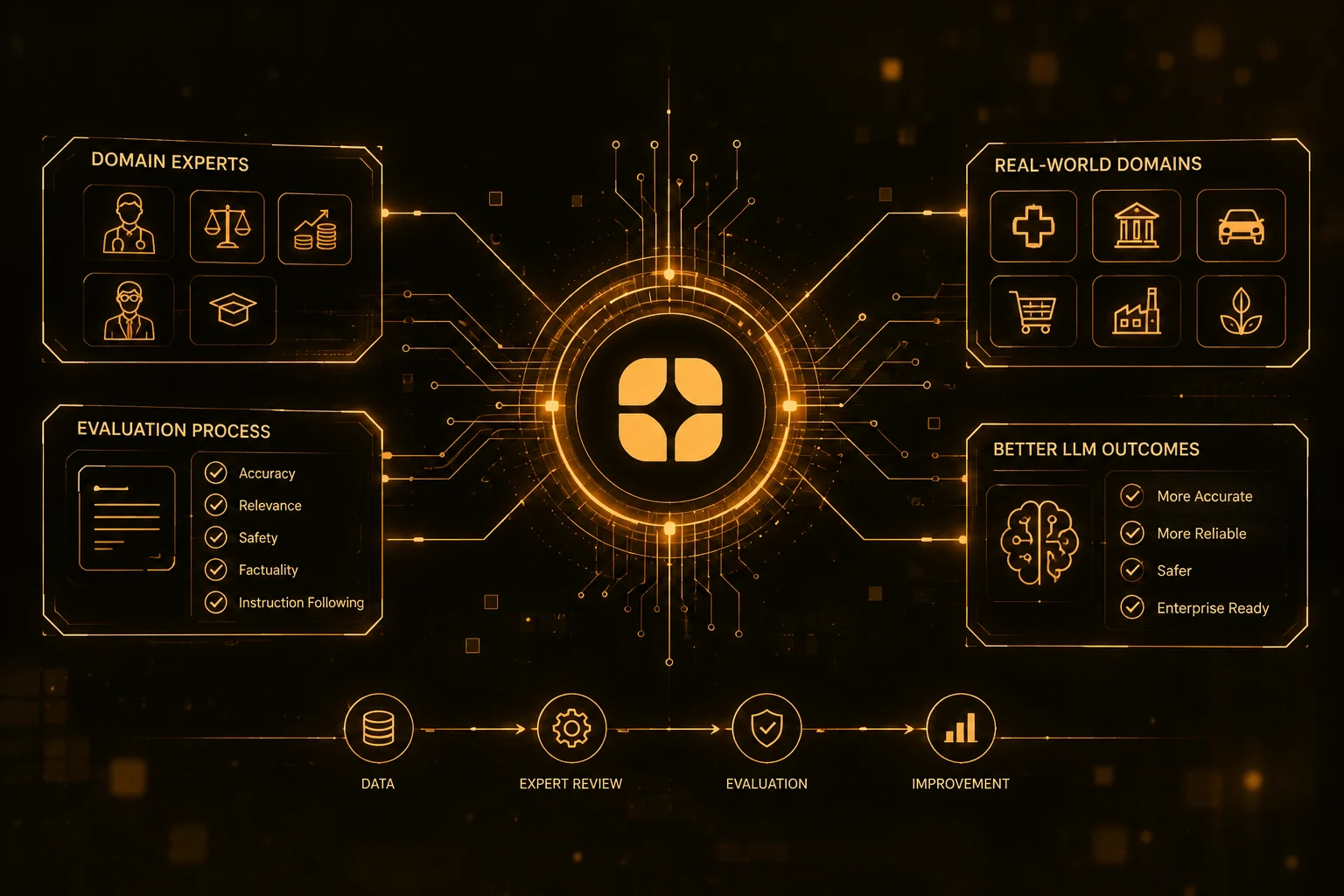
It involves defining correctness criteria with input from genuine domain experts, evaluating model outputs against real business scenarios, categorizing errors by domain-relevant failure type, testing edge cases informed by real domain knowledge, and measuring consistency across expert evaluators.
Model-based evaluation can offer scale and speed, but without genuine human domain expert oversight and calibration, it risks reflecting the evaluating model's own blind spots and biases, rather than genuinely verifying correctness against real-world domain standards.
Because even genuine domain experts can apply judgment inconsistently on ambiguous cases, and measuring agreement between evaluators helps confirm that evaluation criteria are actually being applied consistently, rather than reflecting one reviewer's individual interpretation.