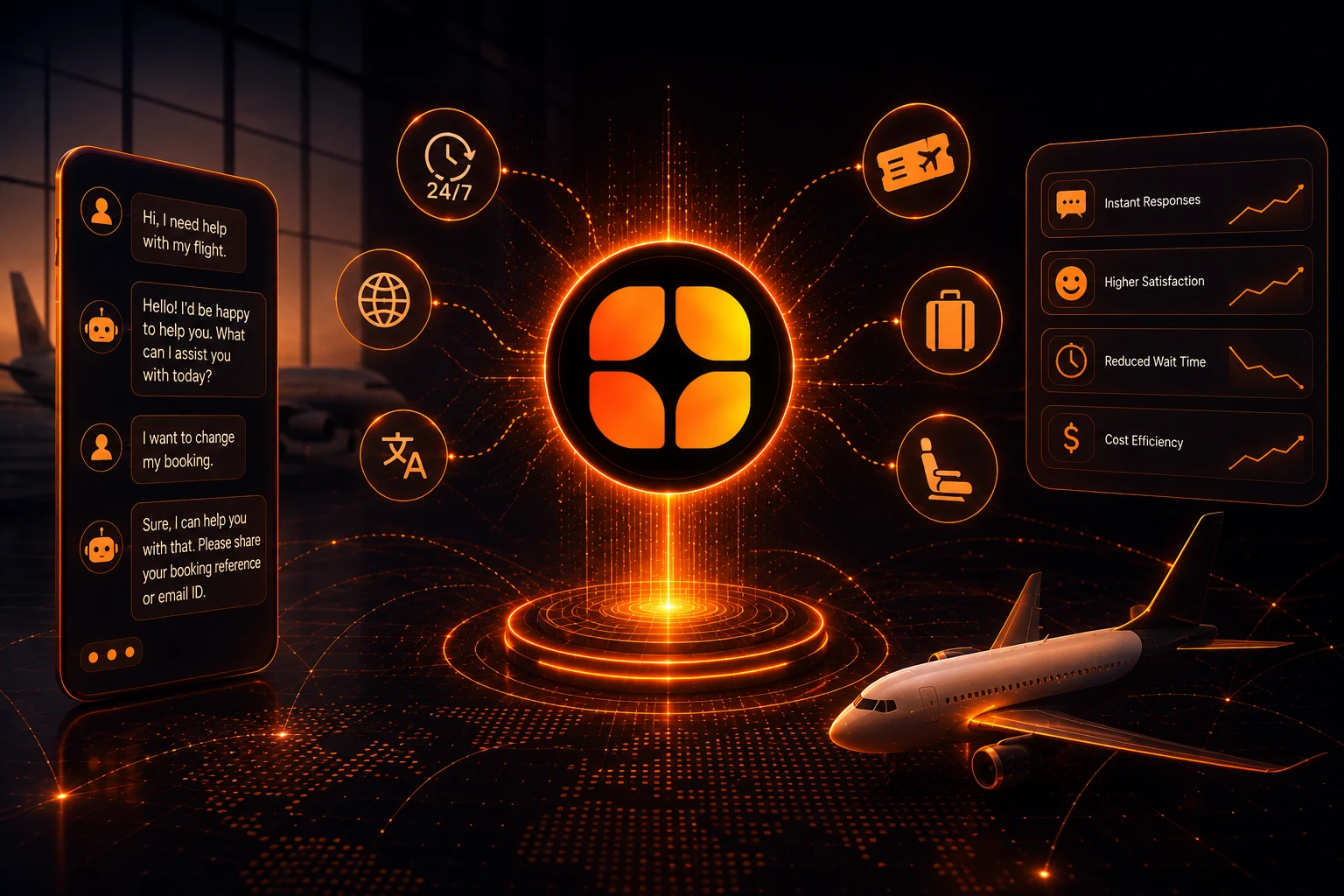
Few industries put customer support under as much sudden, unpredictable pressure as airlines. A single weather event can cascade into thousands of delayed and cancelled flights within hours, each one generating a passenger who needs to rebook, understand their compensation rights, or simply find out what's happening next. Traditional call centers, built around linear queues and scripted decision trees, buckle under exactly this kind of surge, precisely when passengers are most frustrated and need help the most. Forrester's 2026 airline prediction specifically warns that this pressure is intensifying further, as consumer-built bots and personal AI assistants increasingly flood airline call centers during weather events, with a single passenger's own AI agent calling the carrier repeatedly to rebook during a storm.
This is the backdrop against which conversational AI has moved from a nice-to-have chat widget to something closer to core airline infrastructure. In 2026, AI is transforming the passenger journey from booking to baggage claim, with conversational bots now rebooking delayed flights in seconds and predictive systems spotting maintenance issues before takeoff.But the more interesting story isn't that airlines have chatbots now. It's how fundamentally conversational AI's role has shifted, from answering simple FAQs to actually executing the complex, high-stakes workflows that used to require a human agent and a long hold time.
Early airline chatbots ran on deterministic flows that were difficult to maintain, and if a customer veered off the expected script, the bot typically couldn't adapt the conversation without forcing the customer to start over.A decade of this style of airline chatbot, intent-classifier-driven, single-channel, knowledge-base-bound, generally peaked around 25 to 30 percent automation and then stalled there.
More recently, AI agents have expanded what's actually possible, adapting more easily to shifts in conversation and taking real action within internal systems to resolve a broader range of customer issues.Modern conversational AI now understands passenger intent well enough to execute real business tasks directly, booking changes, check-ins, and disruption rebooking, rather than simply routing a request to a human agent or a static help article.</cite> This is a meaningful shift in category, not just a capability upgrade. The gap between an older-style chatbot and what's now emerging as an AI agent platform is architectural: a chatbot answers questions from a knowledge base on a single channel, while an AI agent platform combines conversation with deterministic process execution, reservation system integration, multi-channel orchestration, and a regulatory audit trail in one system.
Real-world deployments illustrate what this looks like in practice. Dutch airline KLM has used conversational AI to manage post-booking and flight change inquiries specifically during peak travel seasons, when call volume surges beyond what human teams can handle efficiently.Wizz Air's virtual assistant, Amelia, provides continuous support covering flight statuses, bookings, baggage, payment methods, check-in procedures, and voluntary cancellations, with a conversational, self-learning personality rather than a rigid script.Other airlines have deployed conversational assistants for genuinely operational use cases too, such as an AI-powered parts bot that streamlines sourcing critical aircraft components, checking availability, tracking orders, and managing related queries across web, voice, and SMS channels.
Real-time disruption management and rebooking. Modern conversational AI is increasingly focused on handling the real-world complexity of flight disruptions, rebookings, loyalty program questions, baggage issues, and irregular operations, rather than just answering routine informational questions. This matters enormously given how often disruption, not routine travel, is what actually drives passengers to seek support in the first place.
Consistent support across every channel. A passenger can book a flight on mobile, continue the conversation through a messaging app, complete check-in at a kiosk, and then switch to voice, all without losing context, since the assistant maintains consistent logic and system access across every touchpoint. This channel continuity is a genuine improvement over the fragmented experience of repeating the same information to a different system or agent at every step.
Multilingual, accessible support at global hubs. International airports serve passengers from deeply diverse linguistic and cultural backgrounds, and airports are increasingly exploring conversational AI and digital assistants specifically to provide real-time support without forcing passengers into physical queues, with multilingual receptionist agents helping improve accessibility across global transit hubs.Some airline-focused platforms already support conversations across 55 or more languages, including right-to-left scripts, reflecting how central genuine multilingual capability has become to this use case.</cite>
Compliance-aware automation for regulated processes. Because airline customer support intersects directly with passenger rights regulation, compensation eligibility, cancellation policy, and accessibility requirements, leading implementations increasingly separate the conversational layer from the business-decision layer. One notable architectural approach uses a deterministic rules layer to handle every actual business decision, such as rebooking logic or compensation eligibility, while a separate conversational model manages only the natural language interaction itself, specifically to avoid the risk of a language model inventing or miscalculating a compensation amount or flight detail.
Airport-specific guidance beyond the airline relationship itself. Airport chatbots have also become a significant part of this shift, helping travelers find flights, navigate terminals, and access airport-specific services, with early examples like Gatwick's assistant managing to understand and answer roughly 80 percent of user questions within its first year of deployment.
The business case behind this shift is substantial and increasingly well documented. McKinsey's airline CIO research estimates AI-driven automation can reduce operating costs by up to 20 percent, with as much as $10 billion in potential revenue upside across personalization and preferred-channel engagement industry-wide.</cite> <cite index="8-1">Separately, Deloitte's 2026 State of AI in the Enterprise research finds that 43 percent of global business leaders expect contact-center cost reductions of 30 percent or more within three years.</cite>
Concrete deployment results back up these broader projections. AirHelp, a major air passenger rights organization, consolidated three separate support tools into a single conversational AI platform, halved its email response times, and reached 48 percent autonomous resolution across 18 languages.</cite> These aren't marginal efficiency gains. They represent a genuine shift in how much of the support workload can be handled without a human agent directly involved in every interaction, freeing human teams to focus specifically on the complex, sensitive, or emotionally difficult cases that genuinely need a person.\
None of this capability exists without training data built specifically for the messy, high-stakes reality of airline customer interactions, and this is exactly where a lot of conversational AI deployments quietly fall short.
Intent alone can't capture airline conversation complexity. A passenger message like "my connecting flight got cancelled and now I need to know if I still get my hotel voucher and whether my bag will make it to my final destination" contains multiple overlapping concerns, disruption handling, compensation policy, and baggage logistics, layered together. Systems trained primarily on simple, single-intent examples struggle badly with exactly the kind of compound, real-world request that dominates disruption scenarios.
Disruption scenarios need deliberately collected, not just naturally occurring, training data. Because major disruptions are relatively infrequent compared to routine travel days, but disproportionately important to get right, training data needs to deliberately capture the specific language, urgency, and multi-step resolution patterns of disruption conversations, rather than relying on whatever naturally accumulates from typical operations.
Multilingual support requires genuine native-language annotation, not just translation. Given how central multilingual capability has become to airline and airport support, building this well requires the same rigor discussed around any genuinely multilingual AI system: native-speaker annotators who understand regional phrasing, code-switching, and cultural context, not a single language translated outward.
Compliance-sensitive conversations need careful, policy-aware training data. Because passenger rights regulations vary by region and route, and because compensation and rebooking decisions carry real financial and legal weight, training data supporting these conversations needs to be grounded in accurate, jurisdiction-aware policy understanding, closely paralleling the kind of regulatory rigor required in legal and fintech annotation.
Escalation judgment needs its own dedicated training data. Knowing when a conversation, a distressed passenger, a genuinely ambiguous compensation case, a situation outside the system's defined scope, should hand off to a human agent is a distinct skill requiring specifically labeled examples, not something that emerges naturally from training focused only on task completion.
Tool-use and system integration annotation underpins every action-taking capability. Because modern airline conversational AI increasingly executes real actions, rebooking a flight, issuing a refund, checking bag status, rather than just answering questions, the underlying training data needs the same kind of tool-use and backend integration annotation that any genuinely agentic AI system depends on.
Prioritize disruption-scenario coverage, not just routine query handling. The moments that matter most for passenger trust are exactly the high-pressure disruption scenarios that are hardest to get right and easiest to underrepresent in training data.
Treat multilingual support as core infrastructure for global operations. Given how linguistically diverse airline passengers genuinely are, multilingual capability needs the same rigor and native-language annotation investment as the primary language a system launches in.
Build clear escalation logic from the start. A system that pushes forward confidently in situations that genuinely needed human judgment, or escalates too aggressively and frustrates passengers with unnecessary handoffs, undermines trust either way.
Separate the conversational layer from business-critical decision logic where possible. Following the architectural pattern increasingly used across the industry, keeping compensation and rebooking calculations in deterministic, auditable systems, while using conversational AI specifically for the natural language interaction, reduces the risk of costly, trust-damaging errors.
Invest in the full data stack, not just intent recognition. As with conversational AI more broadly, airline-specific deployments need dialogue context, tone and escalation handling, tool-use annotation, and compliance-aware labeling working together, not a single intent-classification layer treated as sufficient.
Conversational AI's role in airline customer support has moved well past answering simple FAQs. It's increasingly handling the genuinely complex, high-stakes moments, disruptions, rebookings, compensation questions, that define whether a passenger's experience with an airline was actually good or quietly frustrating. The financial case for this shift is substantial and increasingly well documented, but realizing it depends entirely on training data built specifically for the real complexity of airline conversations: disruption scenarios, genuine multilingual coverage, compliance-aware policy understanding, and the tool-use capability that lets a system actually act, not just talk.
For airlines and the vendors building this technology, the systems that will genuinely redefine customer support aren't the ones with the most polished chat interface. They're the ones built on training data rigorous enough to handle a passenger's worst travel day as well as it handles their best one.
Traditional airline chatbots typically follow rigid, scripted decision trees and struggle when a conversation deviates from the expected path. Modern conversational AI understands passenger intent more flexibly and can execute real business tasks, like rebookings and check-ins, directly within airline systems rather than simply answering from a static knowledge base.
Current deployments handle a wide range of tasks including flight status updates, bookings and cancellations, baggage inquiries, check-in procedures, disruption rebooking, and increasingly, compensation and passenger rights questions tied to specific regulatory policies.
Because disruptions, like weather-driven cancellations, create sudden surges in support demand precisely when passengers are most frustrated, and these scenarios involve genuinely complex, multi-part requests that simpler, routine-query-focused systems handle poorly.
Leading airline and airport-focused platforms increasingly support conversations across dozens of languages, including right-to-left scripts, reflecting how central genuine multilingual capability has become for airlines serving passengers from diverse linguistic backgrounds at international hubs.
Q7: What data challenges do airlines face in building effective conversational AI?Key challenges include capturing genuinely complex, multi-part disruption scenarios, building native-language rather than simply translated multilingual support, ensuring compliance-aware handling of regulated processes like compensation, and developing clear escalation logic for when a conversation should hand off to a human agent.