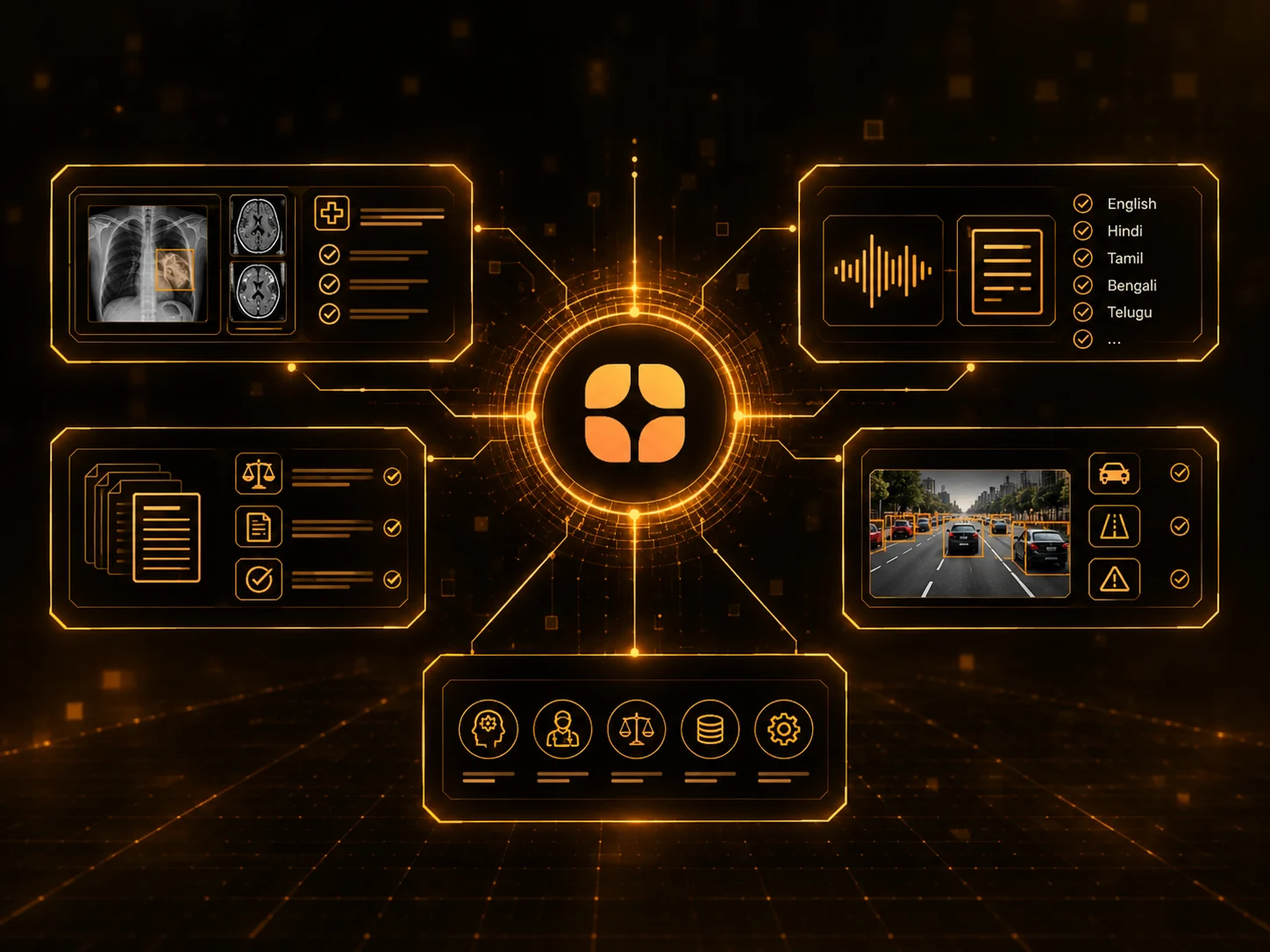
Healthcare sits at the far end of nearly every spectrum that makes AI training data genuinely difficult to get right. The stakes are as high as they get, a wrong output can affect a patient's diagnosis, treatment, or outcome. The data is deeply specialized, requiring years of clinical training to interpret correctly. Privacy regulation is strict and unforgiving. And the underlying reality the data represents, human physiology, disease presentation, treatment response, is genuinely complex and often ambiguous even to experienced clinicians. Building AI training data for healthcare isn't a matter of applying standard annotation practices to medical content. It requires an entirely different level of rigor, purpose-built specifically for the demands of clinical accuracy, regulatory compliance, and patient safety.
This is exactly where a lot of healthcare AI initiatives quietly struggle. A model trained on data labeled by well-meaning but non-clinical annotators, or built without sufficient privacy safeguards, can look reasonable in early testing and then fail in ways that matter enormously once it's actually influencing clinical decisions. Understanding what healthcare AI training data genuinely requires, across imaging, clinical text, structured records, and diagnostic support, is essential for any organization serious about building AI that clinicians and patients can actually trust.
Clinical correctness requires clinical training, not just careful reading. Recognizing a specific pathology in a radiology image, correctly interpreting clinical shorthand in a physician's note, or understanding the significance of a particular lab value combination all require the kind of trained pattern recognition that comes from years of medical education and practice, not something a generalist annotator can reliably replicate regardless of how careful they are.
The cost of a labeling error is unusually direct and severe. A mislabeled training example in most domains produces a marginally less accurate model. A mislabeled training example in healthcare, a missed finding on a scan, an incorrectly coded diagnosis, can propagate into a model that misses or misrepresents exactly the kind of finding that matters most for patient outcomes.
Privacy regulation is strict, specific, and strictly enforced. Healthcare data handling operates under detailed regulatory frameworks governing patient privacy and data protection, and any annotation process touching patient data needs to be built around rigorous de-identification and access control from the outset, not treated as a downstream compliance concern.
Medical knowledge and standards of care evolve continuously. Diagnostic criteria, treatment guidelines, and coding standards are periodically updated as medical understanding advances, meaning healthcare training data needs an ongoing review process to stay clinically current, rather than being treated as a fixed, one-time asset.
Rare conditions are exactly where AI could help most, and exactly where data is thinnest. Many of the conditions where AI-assisted diagnosis could have the greatest impact, catching a rare but serious condition early, are by nature underrepresented in typical clinical data, creating a structural data scarcity problem for exactly the cases where getting it right matters most.
Disagreement among clinicians is normal, not a sign of bad data. Even experienced physicians can reasonably disagree on ambiguous cases, an unclear imaging finding, a borderline diagnostic call, and healthcare annotation processes need to account for this genuine clinical ambiguity rather than forcing every case into an artificially confident single label.
Medical imaging annotation. This includes labeling radiology images, pathology slides, and other diagnostic imaging with identified findings, severity classifications, and precise localization of abnormalities, work that generally requires annotators with genuine clinical or radiological training to perform accurately.
Clinical text and electronic health record annotation. This covers extracting structured information from clinical notes, discharge summaries, and other unstructured medical text, including diagnosis extraction, medication information, and clinical concept recognition, all of which require understanding medical terminology, abbreviations, and clinical documentation conventions.
Diagnostic and clinical decision support data. This involves building training data that connects patient presentations and clinical findings to accurate diagnostic reasoning, supporting AI tools designed to assist, not replace, clinician decision-making.
Genomic and molecular data annotation. For AI applications in precision medicine and genomics, this covers labeling genetic variants, molecular markers, and their clinical significance, requiring specialized expertise in genomics and molecular biology.
Clinical trial and research data annotation. This includes structuring and labeling data from clinical trials and medical research, supporting AI applications in drug discovery, trial matching, and research analysis.
Medical coding and billing data. This covers annotating clinical documentation with accurate diagnostic and procedural codes, work that requires understanding both clinical content and the specific coding standards and conventions used in healthcare administration.
Conversational and patient-facing healthcare AI data. This includes annotation supporting AI-powered patient triage, symptom-checking, and healthcare customer service tools, which need to balance genuine clinical accuracy with appropriate caution about the limits of what an AI system should determine versus refer to a licensed professional.
Licensed clinical professionals for diagnostically significant tasks. For annotation tasks where accuracy genuinely depends on clinical judgment, medical imaging interpretation, diagnosis extraction, clinical decision support, the annotators involved need real clinical credentials and relevant specialty experience, not general healthcare familiarity.
Rigorous de-identification and privacy protection built into the workflow from the start. Patient data used in annotation needs to be properly de-identified before it reaches annotators, with strict access controls and data handling practices maintained throughout the entire annotation pipeline, not applied as an afterthought once labeling is already underway.
Structured handling of clinical disagreement and ambiguity. Rather than forcing artificial consensus on genuinely ambiguous cases, rigorous healthcare annotation processes need a defined path for capturing disagreement among clinical annotators and resolving it through senior clinical review, documenting the reasoning behind difficult calls.
Specialty-matched annotator expertise. A general practice physician and a subspecialist, a cardiologist reading cardiac imaging, a dermatopathologist reviewing skin biopsies, bring meaningfully different levels of relevant expertise to a given task, and annotation quality depends on matching the right specialty expertise to the specific clinical content involved.
Outcome verification wherever feasible. The strongest healthcare datasets connect labeled clinical findings to confirmed outcomes, did a flagged finding on imaging get confirmed through biopsy or follow-up testing, which grounds the training data in verified clinical reality rather than initial impression alone.
Deliberate strategies for rare condition data scarcity. Given how naturally underrepresented rare conditions are in typical clinical data, healthcare AI training data requires deliberate collection strategies, potentially including collaboration across multiple institutions and carefully anchored synthetic data augmentation, to build sufficient coverage for these clinically important but statistically rare cases.
Ongoing currency with evolving clinical standards. Healthcare annotation guidelines and reference standards need periodic review and updating as diagnostic criteria, treatment guidelines, and coding standards evolve, rather than remaining fixed to whatever clinical understanding existed when a dataset was first built.
Diagnostic imaging AI. Systems assisting with radiology, pathology, and other imaging-based diagnosis depend entirely on annotation performed by clinicians with genuine expertise in interpreting the specific imaging modality involved.
Clinical documentation and EHR-based AI. Tools that extract information from clinical notes, support coding, or summarize patient records need training data reflecting the genuine complexity and variability of real clinical documentation, not simplified, idealized examples.
Diagnostic decision support. AI tools designed to assist clinicians with differential diagnosis or flag potential findings for review need training data grounded in verified clinical reasoning and outcomes, given the direct consequence of both missed findings and false alarms.
Precision medicine and genomics. AI applications connecting genetic and molecular data to clinical significance depend on annotation from specialists with genuine expertise in genomics and its clinical applications.
Patient-facing triage and symptom-checking tools. These applications need training data that appropriately calibrates confidence, correctly and clearly deferring to professional medical evaluation whenever a situation exceeds what an AI system should be determining on its own.
Drug discovery and clinical trial support. AI applications in this space depend on carefully structured, accurately annotated research and trial data to support genuinely reliable analysis and matching.
For healthcare AI companies and the institutions adopting their tools, the case for investing in genuinely clinical-grade annotation goes well beyond typical product quality concerns. A diagnostic support tool built on inadequately annotated data risks producing missed findings or false alarms that directly affect patient care, alongside the very real regulatory and legal exposure that follows from deploying clinical AI without a defensible, well-documented data foundation.
This mirrors the pattern seen across every high-stakes AI vertical, but with even higher stakes attached: healthcare buyers, whether hospital systems, health insurers, or regulatory bodies, increasingly expect vendors to demonstrate exactly how their training data was built, verified, and maintained, not simply assert general clinical accuracy. Vendors who can show genuinely credentialed clinical annotation, rigorous privacy protection, and outcome-grounded verification have a real, durable advantage with buyers who understand exactly what's at stake in choosing a weaker foundation.
Verify annotator clinical credentials specifically, not just general healthcare experience. Ask which specific credentials and specialty experience your annotators hold relative to the clinical content they're actually labeling.
Build privacy protection into the annotation pipeline from day one. De-identification and access control need to be foundational design elements of a healthcare data pipeline, not compliance steps addressed after annotation is already underway.
Plan deliberately for rare condition coverage. Passive data collection will systematically underrepresent exactly the rare but clinically important cases where AI assistance could matter most.
Establish a structured process for clinical disagreement. Genuine clinical ambiguity is normal, and annotation processes need a defined, documented path for resolving it rather than forcing artificial certainty.
Treat healthcare training data as requiring ongoing clinical review. As diagnostic and treatment standards evolve, training data and annotation guidelines need periodic updates to remain clinically current.
Healthcare AI training data sits at the intersection of the highest possible stakes, the deepest specialization requirements, and the strictest privacy demands of any domain AI touches. Generic annotation, built for tasks where careful, general judgment is sufficient, simply isn't equipped to handle the clinical nuance, privacy rigor, and outcome verification that healthcare AI genuinely depends on.
For any organization building AI meant to be trusted in a clinical or healthcare context, investing in genuinely clinical-grade training data, built by licensed professionals with the right specialty expertise, protected by rigorous privacy safeguards, and grounded in verified clinical outcomes, isn't a compliance formality. It's the foundation that determines whether the resulting AI can actually be trusted with something as consequential as a patient's health.
Healthcare AI needs more than annotation — it needs clinical judgment. Globik AI delivers licensed, specialty-matched annotation with privacy built in from day one. Talk to our team
Because clinical correctness depends on specialized medical training, labeling errors carry unusually severe direct consequences for patient care, and healthcare data handling is governed by strict privacy regulation that must be built into the annotation process from the start.
Tasks involving diagnostically significant judgment, such as medical imaging interpretation or diagnosis extraction, generally require licensed clinical professionals with relevant specialty experience, not general healthcare familiarity or generalist annotation skills.
Patient data needs to be properly de-identified before it reaches annotators, with strict access controls and privacy safeguards maintained throughout the entire annotation workflow, built in from the start rather than added as an afterthought.
Because rare conditions are, by nature, underrepresented in typical clinical data, creating a structural scarcity problem for exactly the cases where AI-assisted detection could have the greatest impact on patient outcomes.