For years, building a chatbot meant training an intent classifier. Collect a set of example phrases, label each with the intent it represents, "check order status," "reset password," "cancel subscription," and train a model to sort incoming messages into the right bucket. This approach worked reasonably well for narrow, scripted bots handling a small set of predictable requests, and intent annotation became, for a long time, the default shorthand for what "conversational AI data" even meant.
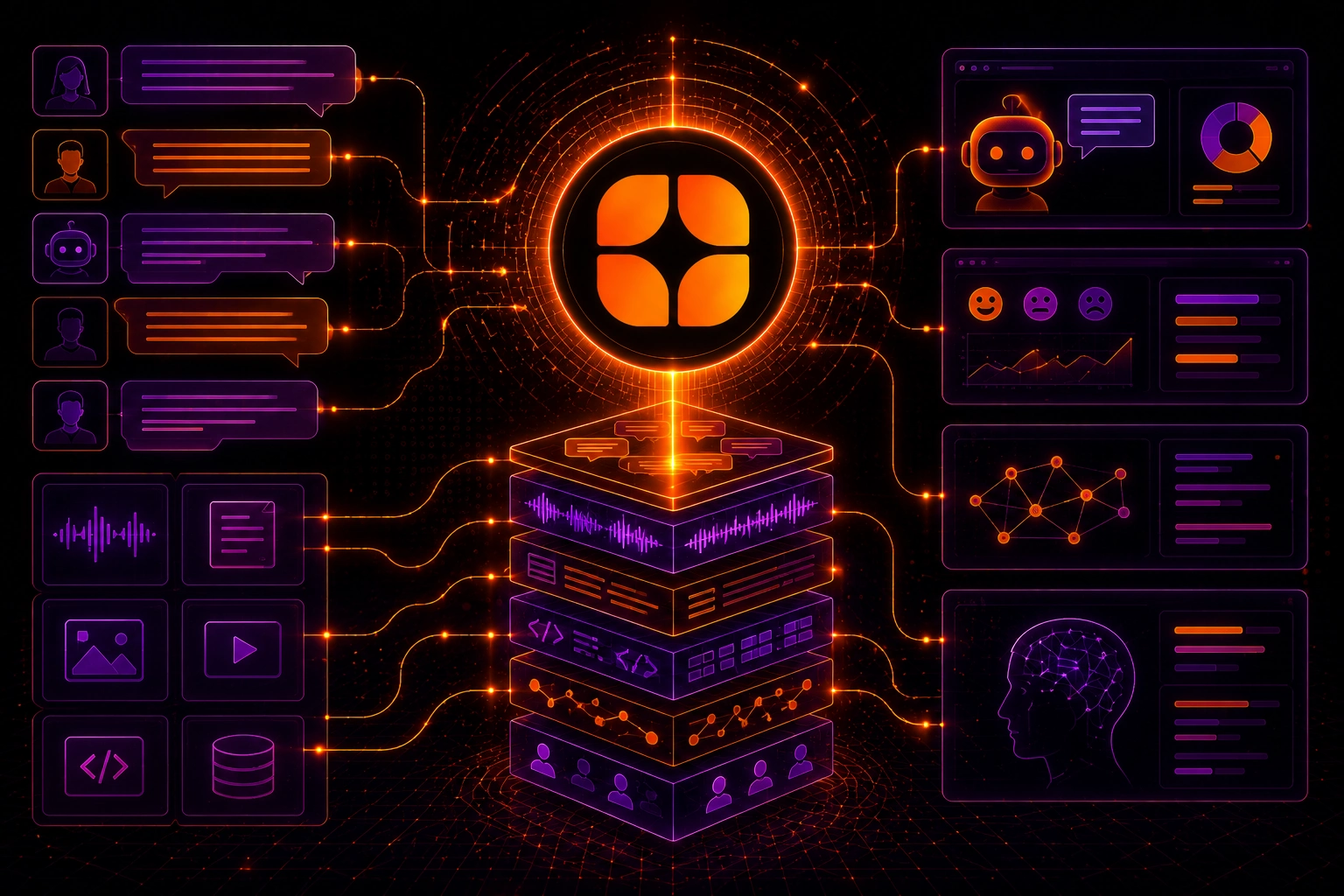
That shorthand is now badly out of date. Modern conversational AI, whether it's a customer service assistant, a sales conversation agent, or a general-purpose assistant handling open-ended dialogue, needs to track context across many turns, handle ambiguity, manage tone and personality consistently, gracefully recover when a conversation goes off-script, and often coordinate with backend systems and tools mid-conversation. None of that is achievable with intent labels alone. Building conversational AI that actually holds up in real deployment requires a full data stack, several distinct, complementary layers of annotation working together, not a single labeling task treated as sufficient on its own.
Intent annotation remains genuinely useful. It's often the right starting point for narrow, well-defined tasks, and it still plays a role within a broader conversational AI data strategy. But treated as the entire foundation, it breaks down for a few clear reasons.
Real conversations rarely map to a single intent. A customer message like "I ordered the wrong size last week and now I want to know if I can still get a refund since the sale price is gone" contains multiple overlapping concerns: a return request, a pricing question, and an implicit time constraint. Reducing this to a single intent label loses most of the information a system actually needs to respond well.
Intent doesn't capture context across turns. A message that reads as ambiguous in isolation, like "what about the blue one," only makes sense in light of what was discussed several turns earlier. Intent classifiers operating on individual messages, without a broader context-tracking layer, miss this entirely.
Intent says nothing about tone, style, or appropriate response framing. Knowing that a user wants to cancel a subscription doesn't tell a system how to respond in a way that matches the brand's voice, appropriately acknowledges frustration if present, or follows a specific de-escalation approach for a sensitive interaction.
Intent doesn't capture what happens when things go wrong. Real conversations frequently involve misunderstandings, topic changes, interruptions, and moments where a system needs to recognize it doesn't have enough information and ask a clarifying question rather than guessing. Intent-only training data provides little guidance for handling these situations gracefully.
Modern conversational AI often needs to take action, not just classify. Systems that check an order status, process a return, or update an account need to interact with backend systems mid-conversation, which requires an entirely different layer of training data beyond identifying what the user wants.
This remains a foundational layer, but a more nuanced one than early chatbot systems required. Modern intent annotation needs to account for multiple, overlapping intents within a single message, and entity annotation, labeling specific pieces of information like product names, dates, or account details, needs to work alongside intent labels to give a system the concrete details it needs to act on a request, not just recognize its general category.
Conversations unfold across multiple turns, and understanding any given message often depends on everything that came before it. Dialogue annotation labels how context should carry forward, tracking references back to earlier parts of a conversation, resolving ambiguous phrases like "that one" or "the second option," and capturing how a conversation's topic shifts and evolves. This layer is what allows a system to actually follow a conversation rather than treating each message as an isolated, context-free event.
Beyond labeling what a user meant, conversational AI needs annotation evaluating how well a system's response performed, both at the level of an individual turn and across the conversation as a whole. A response might be locally reasonable but set up a worse conversation overall, or a system might recover well from an earlier misstep in a way that only becomes apparent looking at the full exchange. This kind of holistic, conversation-level evaluation is essential for training systems that manage extended interactions well, not just individual replies.
For conversational AI representing a specific brand or product, consistency in tone, personality, and communication style matters as much as factual correctness. This layer of annotation evaluates whether responses match a defined persona, whether the tone appropriately adapts to context, such as shifting to a more empathetic register when a customer expresses frustration, and whether the system maintains this consistency across an entire conversation rather than only in isolated responses.
Knowing when to ask a clarifying question, rather than guessing at an ambiguous request, is a distinct skill that needs its own dedicated training data. Similarly, knowing when a conversation has become too complex, sensitive, or high-stakes for the system to continue handling autonomously, and should instead escalate to a human, requires specifically labeled examples of appropriate escalation points. Systems trained without this data tend to either escalate too aggressively, frustrating users with unnecessary handoffs, or not aggressively enough, pushing forward confidently in situations that genuinely warranted human involvement.
Many modern conversational AI systems need to call backend systems mid-conversation: checking an order status, processing a return, or pulling account information. This requires annotation similar to what agentic AI systems need more broadly: labeling whether the correct tool or system was called, whether the request was formatted correctly, and whether the response was interpreted and communicated back to the user accurately.
Conversational AI deployed in front of real customers needs training data specifically addressing how to handle sensitive topics, policy boundaries, and potentially harmful or manipulative user inputs. This layer of annotation is what teaches a system to decline inappropriate requests gracefully, avoid making commitments it isn't authorized to make, and maintain appropriate boundaries throughout a conversation.
Beyond rule-based correctness, conversational AI benefits from human preference data comparing different possible responses to the same conversational context, similar to RLHF used in broader language model training, but applied specifically with attention to conversational qualities: naturalness, appropriate length, tone match, and how well a response sets up the rest of the conversation, not just whether it's factually accurate in isolation.
These data types aren't independent, siloed labeling tasks. They function together as a coordinated stack, where weakness in any single layer limits what the overall system can reliably do, regardless of how strong the other layers are.
A system with excellent intent recognition but no dialogue-context annotation will correctly identify what a user wants in isolation, then fail the moment that request depends on something mentioned three turns earlier. A system with strong context tracking but no escalation annotation might follow a conversation perfectly, right up until it confidently mishandles a situation that genuinely needed human involvement. A system with solid tool-use annotation but weak tone-consistency data might successfully process a return, while doing so in a way that feels jarring or inconsistent with the brand's voice.
This is why building conversational AI well requires thinking about training data as a genuine stack, with each layer addressing a distinct capability, rather than assuming that solving intent classification well is sufficient on its own.
Real multi-turn conversation data, not isolated message-response pairs. Because so much of conversational AI's difficulty lives in context tracking and conversation-level coherence, training and evaluation data needs to be collected and reviewed at the level of full conversations, not individual exchanges viewed in isolation.
Annotators who understand the specific domain and brand context. Judging whether a response matches an intended tone, or whether an escalation was appropriate, requires understanding the specific product, industry, and brand voice involved, not just general conversational fluency.
Deliberate collection of difficult, messy, and ambiguous conversations. Clean, straightforward conversations are the easiest to collect and the least informative for training a system to handle real-world complexity. Strong conversational AI datasets deliberately include ambiguous requests, topic changes, frustrated users, and conversations that required correction or escalation.
Consistent quality evaluation criteria across the whole stack. Because these different annotation layers interact, evaluation criteria need to be coordinated across them, so that a response optimized for tone consistency, for example, isn't accidentally working against clarity or task completion.
Ongoing data refresh as products and policies evolve. Conversational AI systems typically operate against a backdrop of changing products, policies, and common customer questions, which means the underlying training data needs regular updates rather than a single, static build.
Audit your current training data against the full stack, not just intent coverage. Many conversational AI projects that struggle in production are strong on intent recognition and thin on nearly every other layer described here.
Prioritize dialogue-context and escalation data early, not as an afterthought. These layers are often the difference between a system that handles simple, scripted interactions well and one that can be trusted with genuinely open-ended, real-world conversations.
Collect real, messy conversations deliberately, not just clean example dialogues. A dataset that only reflects straightforward, cooperative interactions won't prepare a system for the ambiguity and difficulty of real customer conversations.
Treat tone and persona consistency as a distinct annotation task. Don't assume that a system trained purely for task completion will automatically maintain the right voice; this needs its own deliberate data and evaluation criteria.
Intent annotation was a reasonable foundation for the narrow, scripted chatbots of an earlier era, but it's no longer sufficient for the conversational AI systems businesses are deploying today. Building conversational AI that genuinely holds up in production requires a full data stack: intent and entity recognition, dialogue and context tracking, conversation-level quality evaluation, tone and persona consistency, clarification and escalation judgment, tool-use annotation, safety guardrails, and preference data tuned specifically for dialogue.
Organizations that keep treating conversational AI data as a single labeling task, rather than this coordinated, multi-layered stack, will keep building systems that perform well in narrow demos and struggle the moment a real conversation gets even slightly complicated. Getting the full stack right is what actually separates conversational AI that customers trust from conversational AI that quietly frustrates them.
Intent annotation is the process of labeling a user's message with the underlying purpose or request it represents, such as "check order status" or "cancel subscription," which trains a model to recognize what a user wants.
Because real conversations involve context that carries across multiple turns, ambiguity, tone considerations, and the need to occasionally ask clarifying questions or escalate to a human, none of which intent labels alone can teach a system to handle.
It's annotation that labels how context should carry forward across a conversation, including resolving references to earlier messages and tracking how a conversation's topic shifts over time, allowing a system to understand messages in light of what came before them.
Escalation annotation labels examples of when a conversational AI system should hand off to a human rather than continuing autonomously. It matters because systems without this training data tend to either escalate too often, frustrating users, or not often enough, pushing forward in situations that genuinely needed human judgment.