Every construction project runs on a plan and a schedule, and every week someone has to answer the same question: how far along is the work, really? Project teams used to walk the site with a clipboard. Now they collect photos from fixed cameras, walkthroughs, and handheld devices, far more than anyone can review by hand.
AI can read those photos and report progress, but it learns from labeled images, and construction images are tricky. Construction progress monitoring annotation is the work of labeling what has been built, how far it has got, and where it sits on the project. This post explains what those labels need to capture and why site knowledge matters.
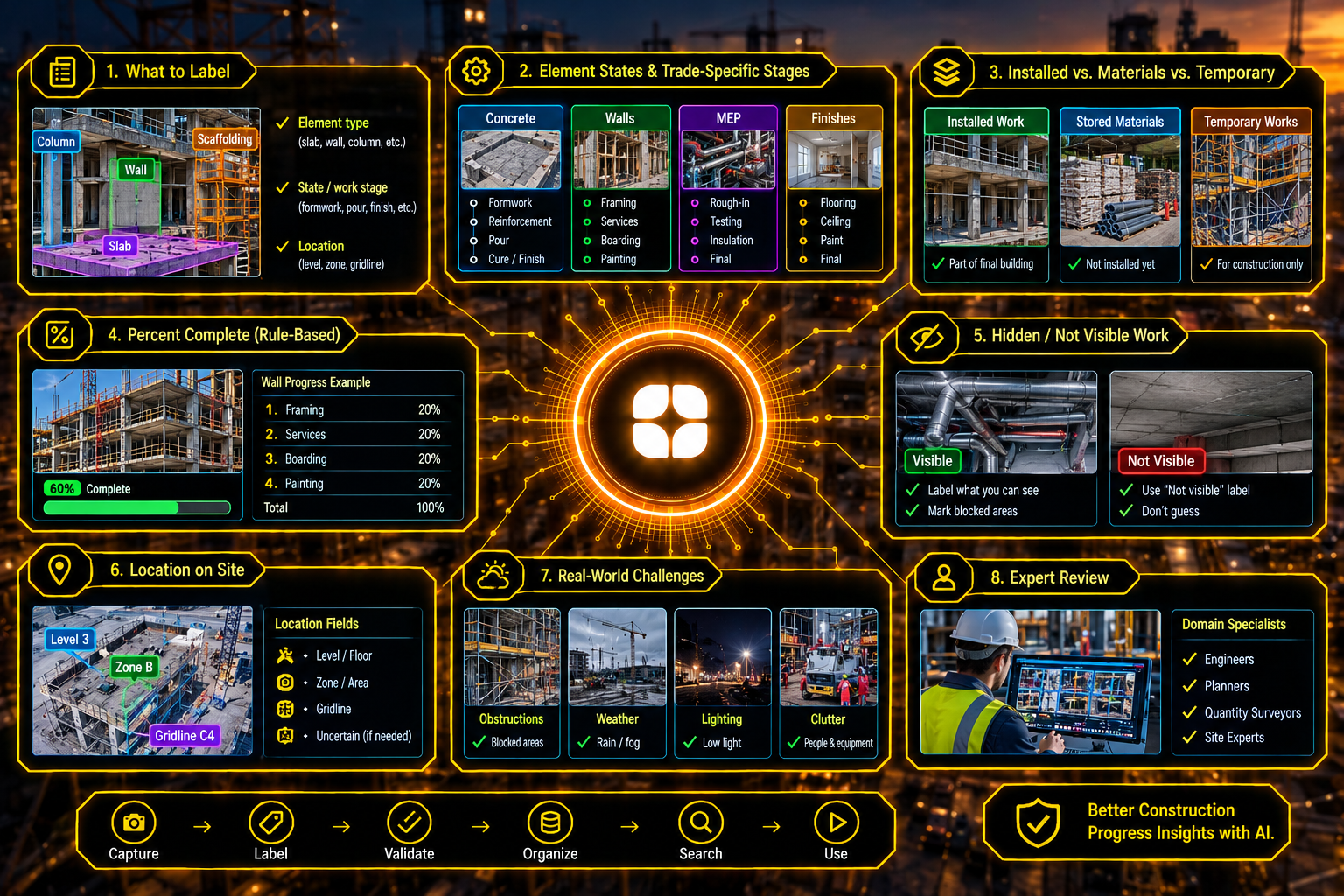
A useful progress label answers three questions at once. What has been built? What state is it in? Where on the project is it?
A photo of a concrete floor is not enough. The team needs to know which floor, which zone, and whether the slab is poured, curing, or finished. Labels that only say "concrete" tell a model nothing it can compare against a schedule.
Good labeling separates two things: the element and its state. The element is the building part, such as a footing, a column, a slab, a wall, a duct, or a ceiling. The state says how far along it is.
State lists differ by trade. A concrete element might move through formwork, reinforcement, pour, and finish. A wall might move through framing, services, boarding, and painting. Each trade needs its own ordered list, defined in plain terms and illustrated with photos.
This is the foundation of work stage labeling. If annotators invent their own stages, the labels will not match the project schedule, and the comparison against the plan falls apart.
Construction sites are full of things that look like progress but are not. Stacks of pipes, pallets of blocks, and rolls of cable sit around waiting. They are materials, not installed work.
Temporary works add another layer. Scaffolding, formwork, props, and hoardings are essential during construction and gone later. They should be labeled as temporary, not as part of the finished building.
Annotators need rules to separate three categories: installed permanent work, temporary works, and stored materials. A model that confuses them will report a pile of bricks as a finished wall.
Teams often want a percentage: this wall is 60 percent complete. Percentages are easy to ask for and hard to label consistently. Two annotators looking at the same half-boarded wall may say 40 and 70.
The fix is to define progress by rule, not by eye. Each element type gets a set of steps, and each step carries a fixed share of credit. A wall that has framing and services done is at a set percentage, whatever it looks like.
Rules should come from the project team's own progress method, so the AI's numbers match the numbers the project already uses.
Some work disappears as the building rises. Reinforcement is hidden once concrete is poured. Pipes and cables vanish behind boards. A photo taken late in the project cannot show what happened inside the wall.
Annotators should label only what is visible. For hidden work, a "not visible" label is honest. Where a record exists from an earlier photo, it can be linked, but the guidelines should say whether an annotator may infer a hidden stage from later work, and how to mark that inference so nobody mistakes it for an observation.
A progress record only helps if it points to a place. Labels should tie each image to a location on the project: the floor or level, the zone, and ideally the gridlines on the plan.
That is harder than it sounds. Many site photos show little that identifies where they were taken, especially inside a half-finished building where every room looks the same. Annotators need the plan, the photo's recorded position or capture sequence, and a way to say "location uncertain." A progress label attached to the wrong floor can send a manager chasing the wrong problem.
Construction images are rarely clean. Scaffolding and netting block the view. Equipment, people, and stacked materials hide parts of the structure. Dust and rain reduce visibility, and interiors may be dim or lit by a single work light.
Annotators need a clear rule for what is too obscured to judge. If the label does not say that an area was blocked, the model will treat the blocked area as empty.
Trades use their own terms, and the same item may have different names in the drawings, the schedule, and the site's everyday talk. A label set that follows one naming scheme will not line up with the others.
Projects should agree on a single vocabulary and map it to the schedule's activity names.
People who work on sites read these photos differently. Site engineers, planners, and quantity surveyors know what each stage looks like, what is temporary, and which work is hidden behind what. They can tell a delivered pile from an installed element and judge how far along a task truly is.
They also write the rules that keep a large team consistent: the stage lists, the progress credit rules, and the handling of hidden or uncertain areas. This matches Globik's approach of using verified domain experts for work that depends on judgment. For construction AI training data, that site knowledge is what makes the labels match how projects are actually managed.
Before a progress imagery project starts, a team can settle five things:
Progress monitoring AI works when labels name the element and its state, separate real work from materials and temporary structures, and tie each finding to a place on the plan. If you are working with site images, you can talk to our team about your site images. Strong construction site imagery annotation depends on people who know how buildings go up.
It is the labeling of site images with what has been built, its state, and its location so AI can report progress.
It lets labels match the project schedule, since each trade moves through its own ordered stages.
Stored materials, scaffolding, and formwork look like progress but are not part of the finished building.
Eyeballed percentages vary between annotators, while fixed credit per step keeps numbers consistent.
It gets a "not visible" label, or a clearly marked inference if the guidelines allow one.