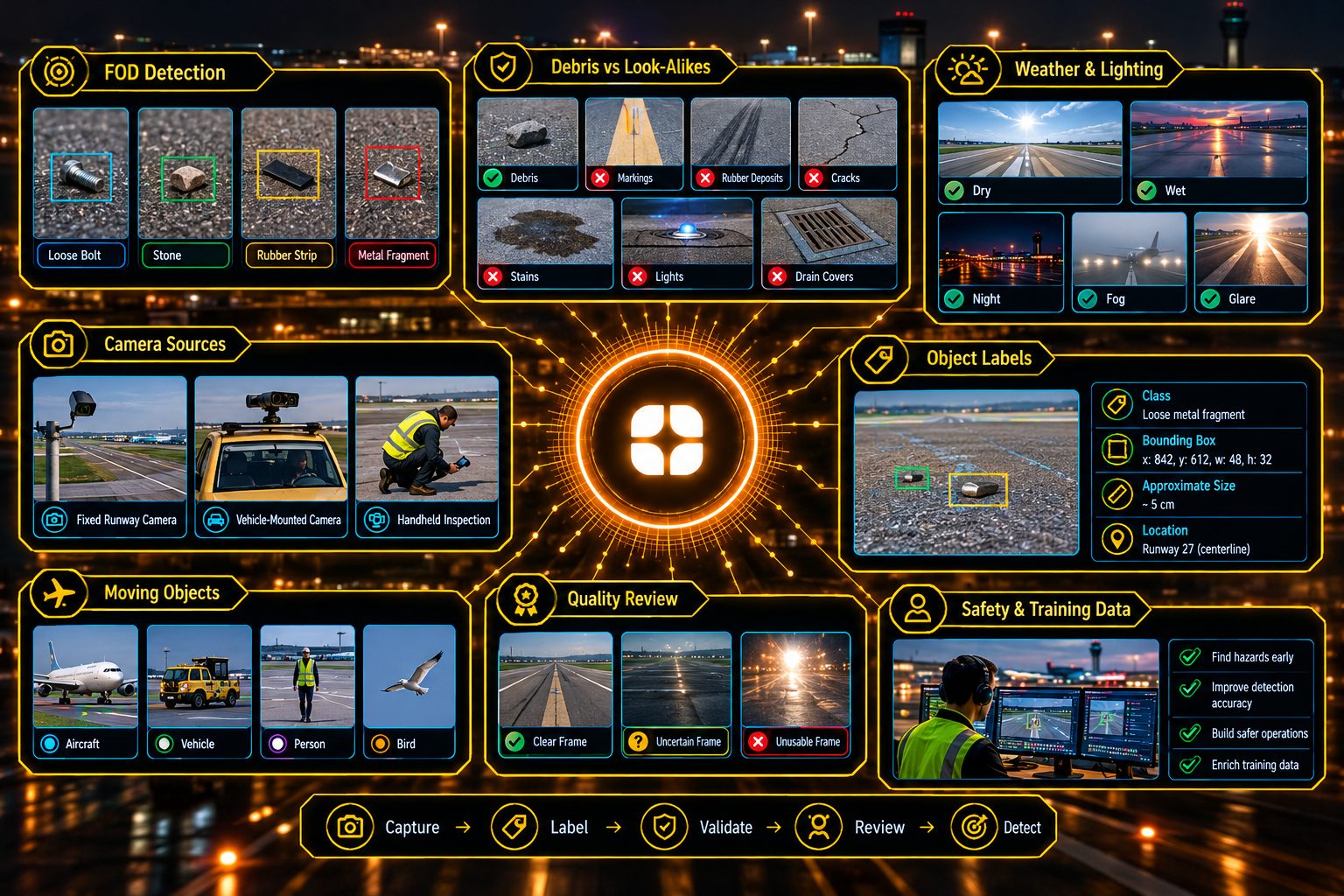
A loose bolt, a strip of rubber, or a small stone on a runway looks harmless on the ground. At high speed, such objects can damage tires and engines. Airports therefore sweep their pavements on a schedule, and many are adding cameras to catch what people on foot or in vehicles might miss.
AI can watch those camera feeds, but it learns from labeled images, and runway images are demanding. Airfield debris detection is the labeling of pavement images so a model can find loose objects and ignore everything else. This post explains why that work is harder than it sounds, what the labels need to record, and why airfield knowledge matters.
The industry often calls loose objects on airfield pavement foreign object debris, or FOD. It covers a wide range: metal fragments, pieces of tire, stones, tools, plastic, and items dropped from vehicles or baggage.
Foreign object debris labeling starts with a clear definition. Debris is a loose object that does not belong on the surface. That excludes three other groups that cause constant confusion:
A model that cannot separate these will raise alerts all day.
Debris is often very small in the image. Cameras sit along the edge of a wide surface, so objects far from the lens may be only a few pixels across. The pavement behind them is textured, with grain, patches, and joints that break up outlines.
Annotators need rules for how small is too small. They also need to decide how to draw boxes around objects with soft edges, and how to treat an object that is partly hidden by a shadow. Written minimum sizes and example images keep annotators consistent.
An airfield surface carries many marks that resemble debris from a distance:
People who know airfields recognize these quickly. Others label them as objects, and the model learns to flag every dark patch.
A reference set helps a great deal. It should include images of the common look-alikes at that site.
Weather and lighting change how a runway looks more than almost any other surface. Rain leaves puddles that reflect lights and sky. Wet pavement turns dark and glossy, and objects can vanish into reflections. At night, runway lights, aircraft landing lights, and vehicle headlights create bright blooms that wash out nearby detail.
A good project tags each image with its conditions, such as dry, wet, night, or fog, so that the model's performance can be checked under each. It also gives annotators a way to mark an image as unusable when conditions hide the surface.
Images come from several sources: cameras fixed along the pavement, cameras mounted on vehicles, and handheld devices used during walking inspections. Each shows the surface from a different height and angle.
A fixed camera sees the same scene repeatedly, so annotators can learn what is permanent and what is new. A vehicle camera moves, so the view changes constantly and blur is common. A handheld image is close and detailed, with a different scale.
The data should record which source produced each image.
Airfields are busy. Aircraft taxi, trucks drive across, and people walk the pavement. Birds land and take off.
None of these are debris, and each should have its own label, not be ignored. Treating them as a separate class teaches the model what normal activity looks like, so it does not raise an alert every time a vehicle crosses the scene.
A useful label tells the airport something it can act on. Beyond the object's class, labels often record an approximate size and where it sits on the pavement: on the runway or a taxiway, near the center or near the edge.
Size is easier to judge with known features. Standard markings and fixed objects of known dimensions give annotators a scale to compare against. The guidelines should say which cues to use, and allow a "size uncertain" label when none are available.
What counts as a hazard, and what response it requires, belongs to the airport's own procedures. Labels should describe what is seen and let the operator decide what follows.
Most frames from a runway camera show nothing at all. That makes clear frames the bulk of the data, and a careless "no debris" label is a quiet mistake.
Reviewers should check that frames labeled clear really are clear, including at the far edges of the view where small objects hide. Frames that cannot be confirmed either way should carry an uncertain label, not a clear one.
People who work in airfield operations or ground safety read these images differently. They know what normally sits on a runway, recognize the look of rubber deposits and worn paint, and understand which objects matter and why. They also write the rules that keep a large team consistent: the definition of debris, the minimum size, and the handling of poor conditions.
This matches Globik's approach of using verified domain experts for work that depends on judgment. For aviation safety AI training data, that experience helps the model flag what matters and leave the rest alone.
Before an airfield imagery project starts, a team can settle five things:
Runway debris AI works when labels define debris carefully, tell it apart from permanent features and moving things, and handle wet, dark, and glaring conditions honestly. For another example of labeling shaped by aviation knowledge, see our guide on aviation maintenance records and technical manual annotation: part numbers, applicability, and revisions. Strong runway debris annotation depends on people who know how an airfield works.
It is the labeling of pavement images so AI can find loose objects that could harm aircraft.
It is a loose object on an airfield surface that does not belong there, often called FOD.
Markings, rubber deposits, cracks, and stains can look like objects, so annotators need a site reference set.
They are not debris, and each is handled differently, so they need their own classes.
Most frames show nothing, so a careless "clear" label hides small objects at the edges.