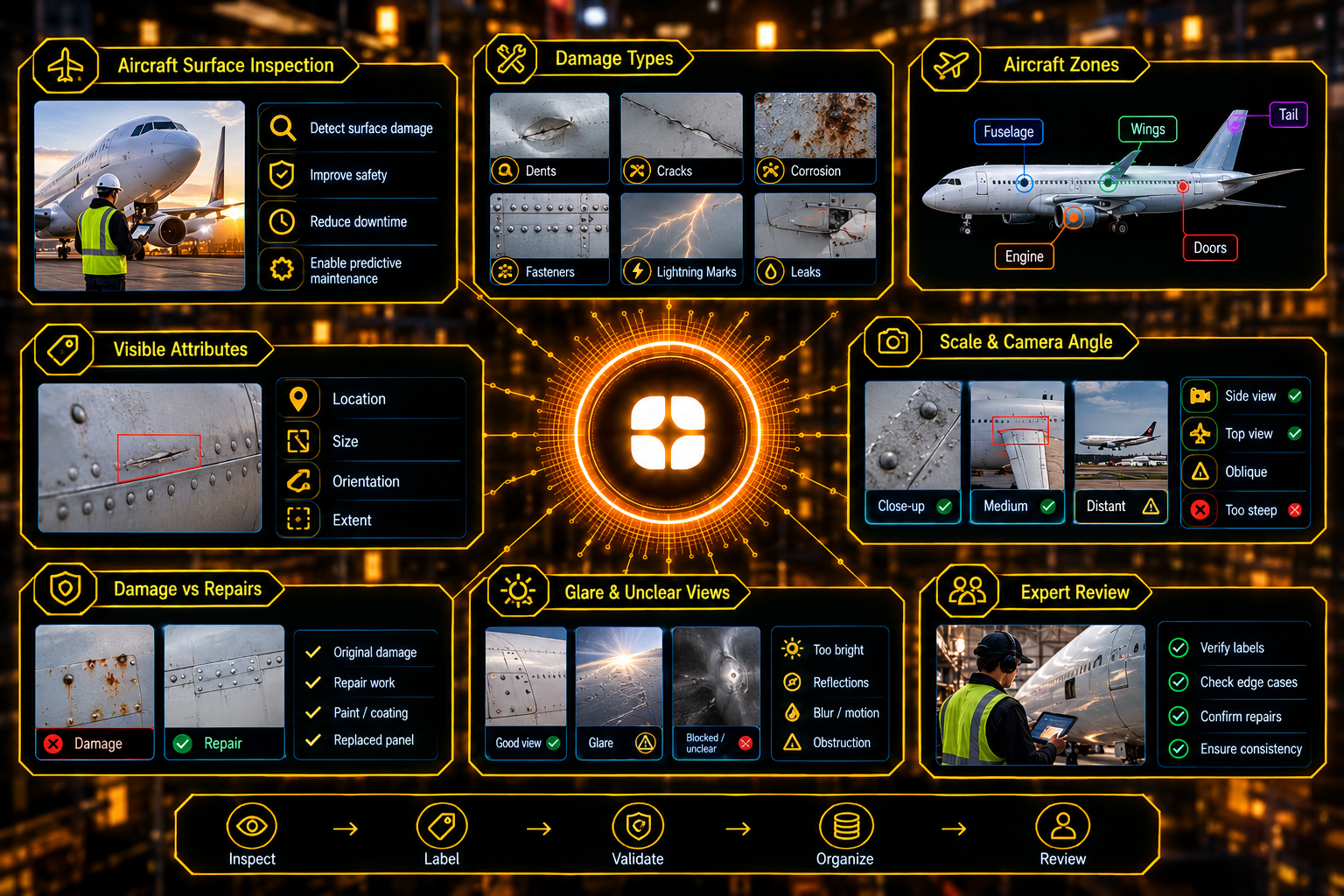
Before and after flights, aircraft are inspected by people walking around them, looking for anything that does not belong. A dent, a crack, a patch of corrosion, or a missing fastener may be small, but each one has to be found, recorded, and judged. Doing this by eye across a large airframe takes time, and photos taken during inspections pile up fast.
AI can help by flagging areas that deserve a closer look. It learns from labeled images, and those labels must be made with care. Aircraft surface inspection annotation is the work of marking damage and surface conditions in images so a model can find them. This post explains what the labels need to capture, why a verdict is not the same as a label, and why aviation knowledge matters.
Surface inspection covers a range of conditions:
Each has its own appearance, and many look like harmless things. That is where the labeling difficulty begins.
An aircraft is divided into zones, such as the fuselage, wings, tail, engine housings, doors, and control surfaces. A mark that is acceptable in one area may need attention in another, because the structure and the loads on it differ.
Limits for damage are set out in the aircraft's maintenance documentation, and they depend on the zone. For this reason, every label should carry the zone and, where possible, the specific panel. A dent label with no location cannot be used, because nobody can say whether it falls within limits.
This is why aviation inspection imagery needs a zone map as part of the project. Annotators should know how the aircraft is divided and how to find a given panel in a photo.
A common mistake is to label an image as "acceptable" or "not acceptable." That decision belongs to a qualified inspector working from the manual. An annotator is not in a position to make it, and a model trained on those verdicts learns someone's opinion, not the rules.
Better labels describe what can be seen and measured: the type of indication, its location, its approximate size, its orientation, and its visible extent. Downstream systems and inspectors can then apply the manual's limits to that description.
This keeps the AI in its proper role. It finds and describes candidates, and a person decides what they mean.
Size is hard to judge from a photograph. A dent that looks large may be small, and the reverse. Depth cannot be seen at all in a flat image.
Good projects use a reference scale, such as a ruler or a known feature in the frame, whenever size matters. They also record the distance and angle of the camera, because a mark seen at a steep angle looks different from one seen straight on. Curved surfaces add further distortion.
When a photo does not allow a reliable size estimate, annotators should record the indication and mark the size as "needs measurement." A guess presented as a measurement is worse than no measurement.
Aircraft surfaces carry many marks that are not damage. Dirt streaks run back from rivets. Fluid stains look dark but are cosmetic. Tape, stickers, and temporary markings sit on the skin. Paint touch-ups change color slightly.
Two cases need special rules:
Annotators with aircraft experience can tell these apart. Others tend to mark everything unusual, which produces a model that cries wolf.
An aircraft panel carries hundreds of fasteners in neat rows. Spotting a missing, loose, or damaged one means looking at every single head.
The labeling rules should say how to handle small objects: how small is too small, how to mark a gap where a fastener should be, and what signs suggest looseness, such as cracked paint around the head.
Inspection photos are taken under overhead hangar lights, in daylight on the ramp, or at night under floodlights. Polished and painted surfaces reflect all of it. A reflection can hide a crack or imitate one, and curved panels bend those reflections into odd shapes.
Annotators need rules for what to do when a surface cannot be judged. A "cannot judge" label is better than a guess, and it tells the team where better photos are needed.
People who work in aircraft maintenance read these images differently. They know the zones, recognize the look of corrosion and impact damage, can tell a repair from a defect, and understand why a mark's location matters as much as its size. They also write the rules that keep a large team consistent: the zone map, the attribute list, and the handling of unclear images.
This matches Globik's approach of using verified domain experts for work that depends on judgment. For aerospace AI training data, that experience is what makes the labels dependable enough to support a qualified inspector.
Before an aircraft surface imagery project starts, a team can settle five things:
Aircraft inspection AI works when labels record where a mark is and what it looks like, leave verdicts to qualified people, and tell damage from repairs and dirt. If you are working with inspection images, you can talk to our team about your inspection data. Strong aircraft damage detection data depends on people who know the airframe.
1. What is aircraft surface inspection annotation?
It is the labeling of images of aircraft surfaces so AI can find dents, cracks, corrosion, and other conditions.
2. Why does the zone of a mark matter?
Damage limits depend on where a mark sits on the aircraft, so every label needs its zone and panel.
3. Why label attributes instead of accept or reject?
That decision belongs to a qualified inspector using the manual, so labels describe what is visible and measurable.
4. Why are repairs labeled separately from damage?
Patches and re-sealed panels are finished work, and mixing them with damage causes false flags.
5. Why use aviation specialists for labeling?
They know the zones, can tell damage from repairs and dirt, and write consistent rules.