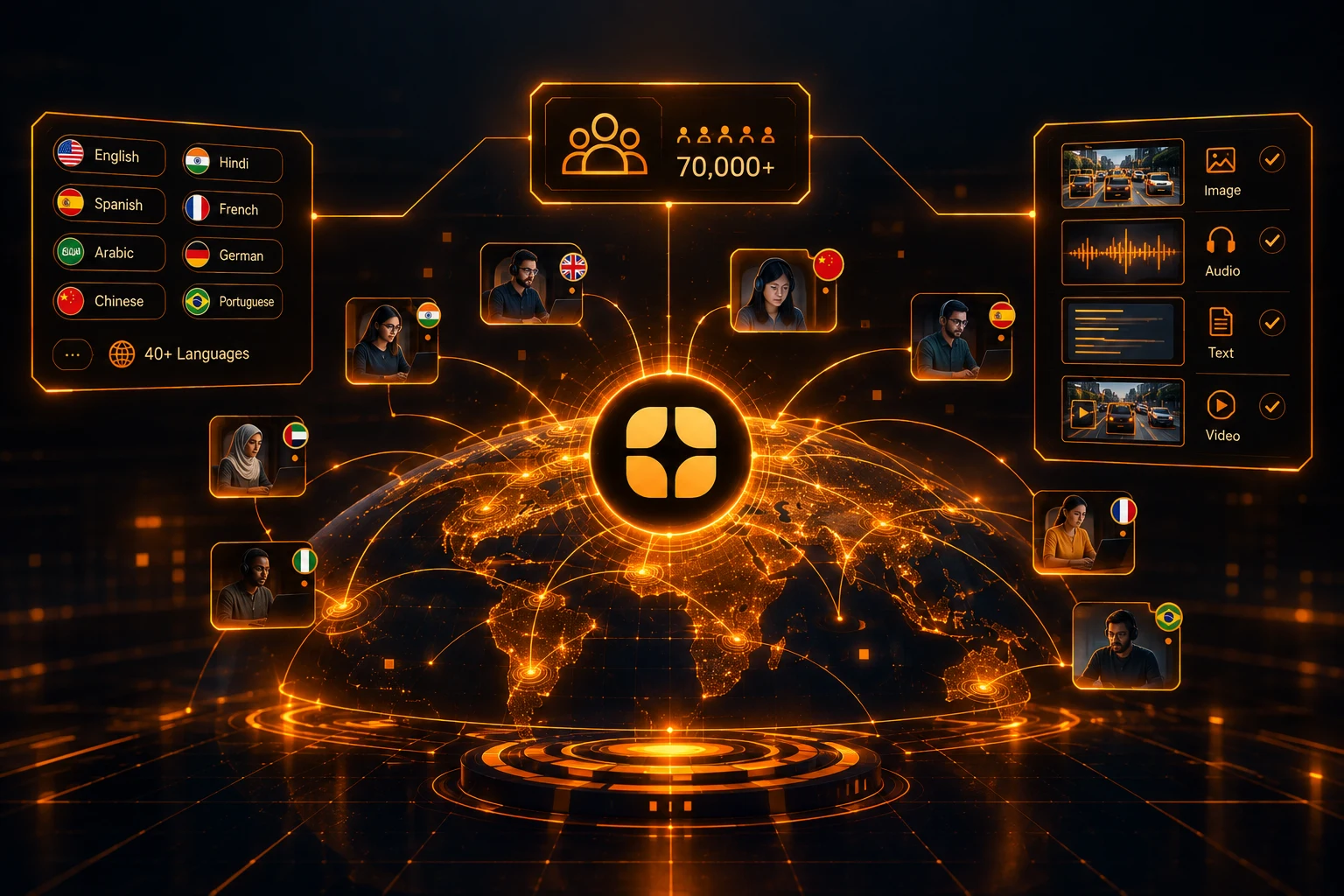
Every AI company talks about scale. Fewer can explain what scale actually looks like on the ground how tens of thousands of individual people, spread across dozens of countries and languages, are recruited, verified, trained, matched to work, and held to a consistent quality bar without the whole system collapsing into chaos.
Globik Workforce runs on exactly that scale: a network of over 70,000 contributors spanning more than 40 languages, including a deep bench of Indic languages, working across healthcare, legal, finance, agriculture, linguistics, and technology. Numbers like that tend to get used as a headline and left unexamined. This post goes the other direction it walks through the actual mechanics of how a distributed annotation workforce this large is built and operated, and why the architecture behind it matters as much as the headcount itself.
A note on framing: the workflow described here reflects how large-scale distributed annotation networks are generally structured and the best practices that make them reliable, rather than a disclosure of Globik's internal systems documentation.
It's tempting to think of scaling an annotation workforce as a hiring problem: recruit more people, assign more tasks. In practice, scale creates three compounding challenges that have nothing to do with headcount and everything to do with coordination.
Consistency at scale is a quality problem, not a staffing problem. Two annotators applying the same guideline to the same data point should produce the same label. That's trivial with ten annotators reviewing each other's work informally. It becomes genuinely hard with thousands of annotators working asynchronously across time zones, which is why inter-annotator agreement the degree to which independent annotators agree on the same data becomes a formal, measured metric rather than an assumption.
Domain coverage doesn't scale linearly with headcount. A workforce of 70,000 people is not 70,000 interchangeable generalists. It's a set of overlapping specialist pools clinicians who can annotate medical imaging, paralegals who can verify contract clauses, agronomists who can label crop disease in field photography, linguists who can handle code-switching in low-resource Indic languages. Growing the workforce means growing each of those pools in proportion to actual project demand, not just growing a single generic labeling pool.
Language coverage is not just translation. Supporting 40+ languages for annotation work means far more than having a translator on call. It means contributors who understand regional dialects, script variations, code-mixing patterns common in everyday speech, and domain-specific terminology in each language the kind of fluency that only comes from native speakers working in their own linguistic and cultural context, not from machine-translated guidelines applied uniformly across languages.
A workforce of this size cannot be built through ad hoc hiring. It requires a structured pipeline that filters for genuine domain competence before a single contributor touches production data.
Sourcing by domain and geography. Rather than recruiting a single undifferentiated labor pool, sourcing is targeted: legal contributors are sourced from paralegal and law-adjacent backgrounds, healthcare contributors from clinical or health-sciences backgrounds, and language specialists specifically for the Indic and regional languages a project needs. This is what allows a platform like Globik Workforce to credibly serve verticals as different as agriculture and fintech from the same underlying network.
Skills verification before assignment. Contributors typically complete domain-specific qualification tasks before being cleared for paid production work not a generic aptitude test, but tasks that resemble the actual annotation work in that vertical, scored against a known-correct answer set. This step exists specifically to catch the gap between someone claiming domain knowledge and someone who can reliably apply it to ambiguous, real-world data.
Guideline training, not just task training. Contributors are trained on the reasoning behind an annotation guideline, not only the mechanical steps of using a labeling interface. This matters because most real annotation work involves edge cases the guideline didn't explicitly anticipate, and a contributor who understands why a rule exists can apply it sensibly to a case the rule never mentioned while a contributor trained only on the interface cannot.
Calibration rounds. Before full production work begins, small batches are typically run through multiple contributors and compared, so early disagreements can be resolved through clarified guidelines rather than discovered later at scale, when the cost of a systematic labeling error is far higher.
With a pool this large and this specialized, the harder problem often isn't finding qualified people it's routing the right people to the right project at the right time.
Matching typically accounts for several factors simultaneously: domain expertise (a legal contract review task and a legal case-summary task may require different sub-specialties even within "legal"), language and dialect fit, prior performance and accuracy history on similar task types, and availability given the platform's flexible, remote-first structure. Getting this matching right is what allows a project requiring, say, Marathi-speaking agricultural specialists to be staffed correctly instead of being handled by whichever contributors happen to be available.
Recruitment and matching only solve half the problem. The other half is making sure output quality holds steady across a workforce this large and this geographically distributed which requires quality control built into the workflow itself, not bolted on afterward.
Layered review. Production annotation work is typically reviewed in stages rather than accepted on first pass: an initial annotation layer, a review layer that checks the first layer's work, and an escalation path for disagreements or ambiguous cases that neither layer can resolve confidently. This layered structure is what allows quality to hold even as volume scales, because errors are caught and corrected within the pipeline rather than surfacing only after delivery.
Ongoing accuracy tracking. Rather than a one-time qualification score, contributor accuracy is typically tracked continuously against gold-standard data seeded into regular work, so drift in quality is caught early and addressed through targeted retraining rather than discovered at project completion.
Guideline refinement as a continuous process. Annotation guidelines are rarely perfect on day one. A mature workforce operation treats disagreement data cases where contributors disagreed with each other or with a gold answer as a signal to refine the guideline itself, not just to retrain the individual annotator. Over time, this closes the gap between what a guideline says and what a domain expert would actually do in practice.
It's easy to list "40+ languages" as a bullet point and move on, but the operational reality behind that number is what actually determines whether annotated data is usable for training a production model.
Supporting a language for annotation work means being able to handle its regional variation (Hindi annotation guidelines that don't account for regional dialect differences will produce inconsistent labels), its script and transliteration quirks, and the way people actually write and speak in informal, code-mixed contexts online which often looks very different from the formal register a translation service would default to. This is precisely the gap that a workforce built from native speakers embedded in their own linguistic context is positioned to close, and it's a meaningfully different capability than running text through a translation layer and applying English-language guidelines on top.
The point of building a workforce this way sourced by domain, verified before production, matched deliberately, reviewed in layers, and refined continuously isn't scale for its own sake. It's what makes it possible to take on projects that a smaller or less specialized network simply couldn't handle credibly: a healthcare dataset requiring clinical judgment, a legal dataset requiring jurisdiction-specific reasoning, an agricultural dataset requiring on-the-ground crop knowledge in a regional language, all running concurrently without quality degrading in any single vertical.
It also enables flexibility on the client side. Because the underlying network already spans this many domains and languages, standing up a new project in an adjacent vertical or an additional Indic language doesn't require building a new workforce from scratch it means routing an existing, already-vetted specialist pool to new work.
A number like "70,000 contributors across 40+ languages" is only meaningful once you understand the system behind it: targeted sourcing by domain and geography, verification before production work, deliberate matching rather than first-available assignment, layered quality review, and continuous guideline refinement based on real disagreement data. That architecture not the headcount alone is what allows a distributed workforce to deliver dataset quality that a smaller, generalist labeling pool structurally cannot. For AI teams evaluating annotation partners, the right question isn't "how many contributors do you have," but "how is that workforce actually built, verified, and managed" and that's the question this kind of infrastructure is built to answer.
Globik Workforce coordinates a network of over 70,000 contributors across more than 40 languages, including deep coverage of Indic languages, working across healthcare, legal, finance, agriculture, linguistics, and technology.
Contributors typically go through domain-specific qualification tasks scored against known-correct answers, followed by guideline training focused on the reasoning behind annotation rules, before being cleared for production work.
Through layered review (an annotation layer, a review layer, and an escalation path for disagreements), continuous accuracy tracking against gold-standard data, and ongoing refinement of annotation guidelines based on real disagreement patterns.
It means contributors who are native speakers handling regional dialects, script variations, and informal or code-mixed language as it's actually used not annotation guidelines translated once and applied uniformly across every language.
Matching accounts for domain expertise, language and dialect fit, prior accuracy on similar task types, and availability, so specialized projects are routed to genuinely qualified contributors rather than whoever is available first.